
A guide to safety data sheets for UK workplaces — what the sixteen sections contain, what's legally required, and how the SDS feeds into your COSHH risk assessment.
Every hazardous substance sold in the UK comes with a safety data sheet (SDS). It's the document that tells you what the substance is, how dangerous it is, what controls the supplier recommends, and what to do if something goes wrong. For a COSHH risk assessment, the SDS is the starting point — the source you draw on for the hazards, the controls and the emergency arrangements.
A note on terminology before we go further. You'll sometimes see SDSs referred to as "MSDS" or "material safety data sheets". MSDS is the older term, from before the Globally Harmonised System was adopted. Current UK and EU regulation uses "SDS". The two terms refer to the same document, but a sheet still titled "MSDS" is likely several years out of date and probably needs replacing.
This page covers what an SDS contains, how to read one, and how it connects to the rest of COSHH. For the broader picture, see what COSHH is, and for the symbols you'll see on labels and in Section 2 of the SDS, see COSHH symbols and their meanings.
The legal basis: UK REACH Article 31
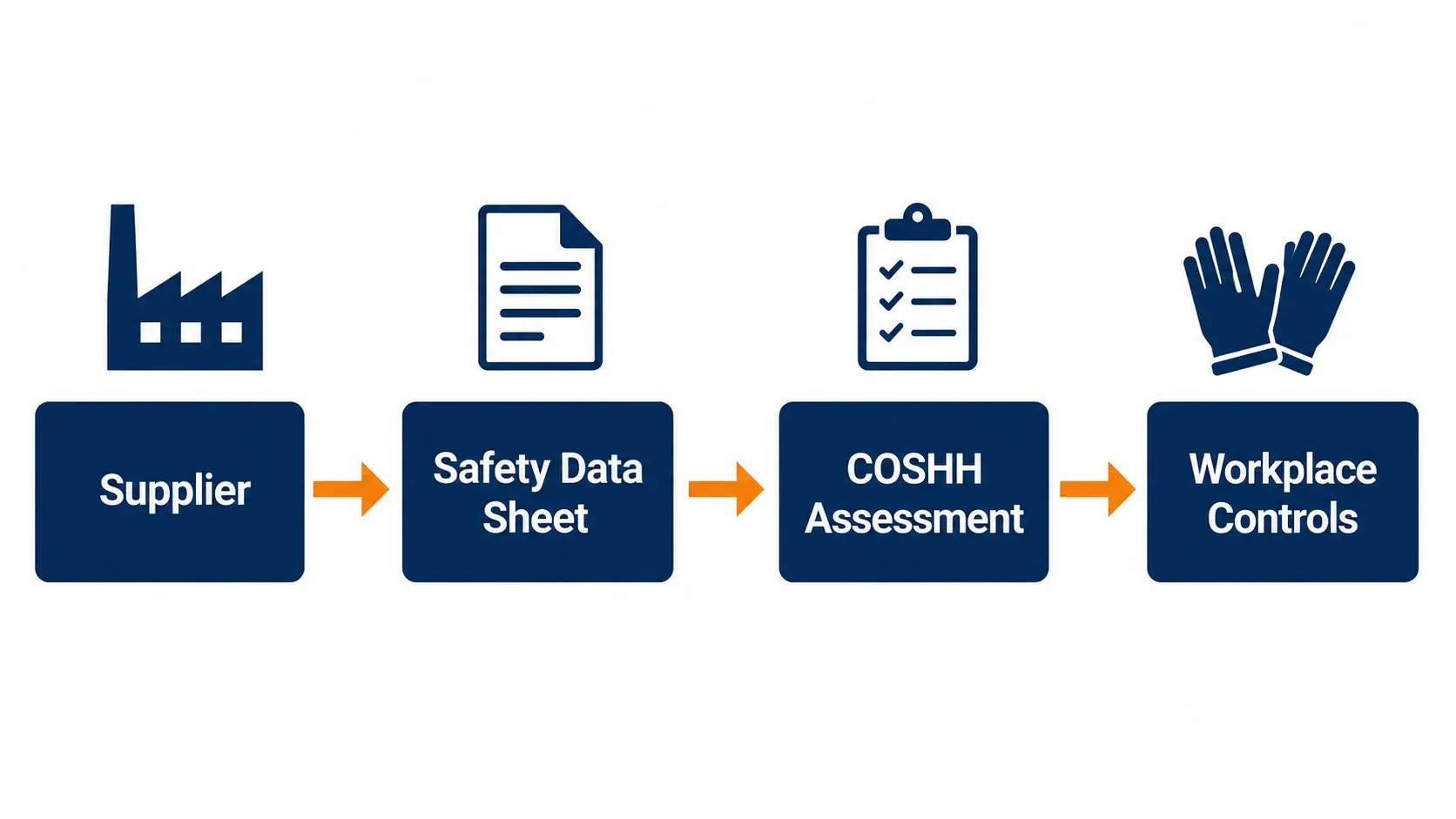
The duty to provide a safety data sheet comes from Article 31 of UK REACH (the Registration, Evaluation, Authorisation and Restriction of Chemicals Regulation). UK REACH is the retained version of the EU REACH Regulation, brought into UK law after Brexit. In Northern Ireland the EU REACH Regulation continues to apply under the Windsor Framework, with HSE acting as the Article 31 competent authority for Northern Ireland through dual compliance arrangements.
The Article 31 duty sits on the supplier — the manufacturer, importer or downstream user that places a hazardous substance on the market. Where a substance or mixture is classified as hazardous under GB CLP, or meets certain other criteria, the supplier must provide an SDS in English, free of charge, to commercial recipients. The SDS must be supplied automatically with the first delivery and updated whenever new significant information becomes available.
There's no equivalent legal obligation to provide an SDS to consumer end-users (which is why a bottle of household bleach in a supermarket doesn't come with one). The threshold is commercial supply for use at work.
The sixteen sections
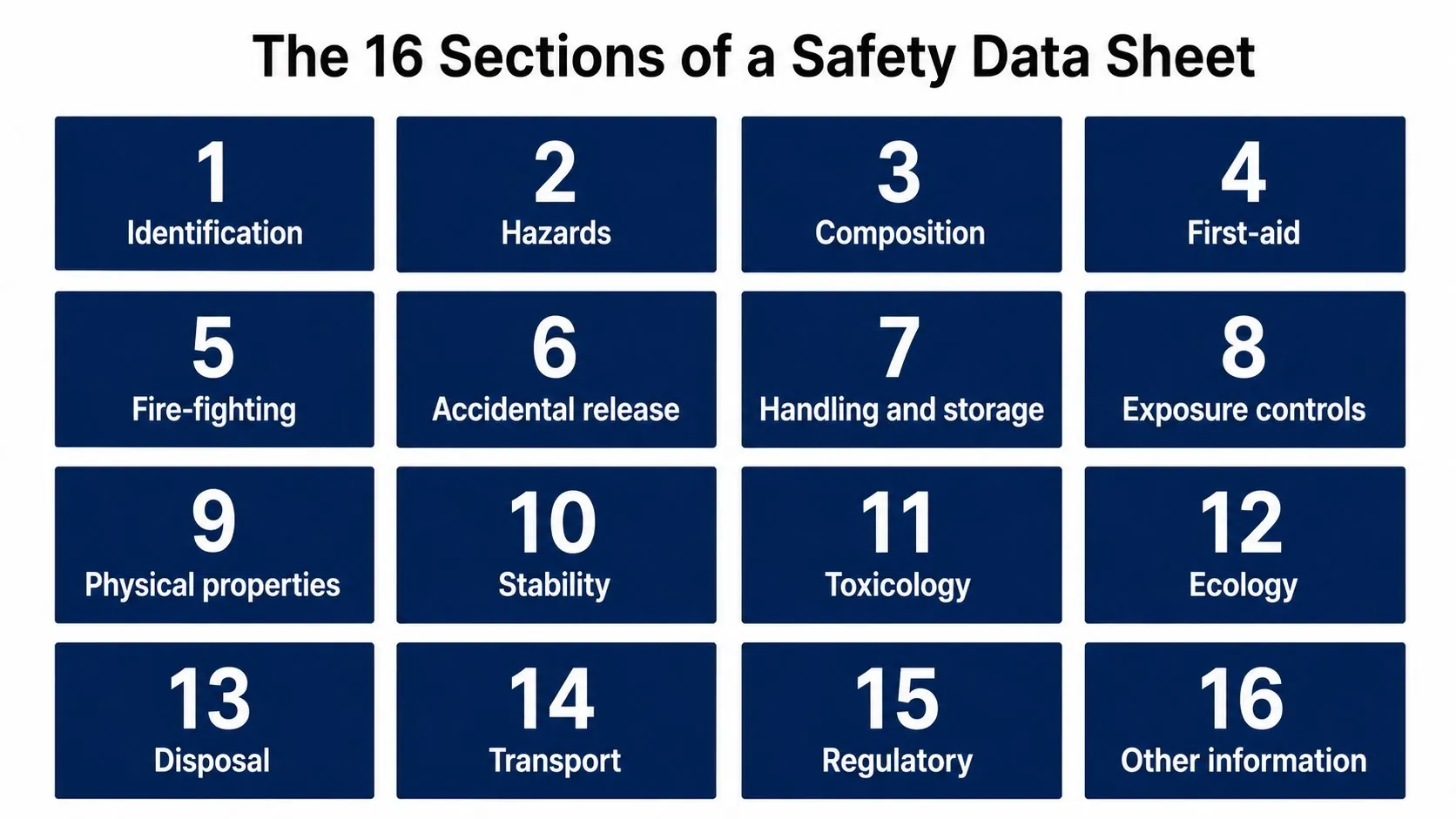
Annex II of UK REACH sets out the standard format for an SDS. There are sixteen numbered sections, in a fixed order, with the content of each section specified in detail. The format is harmonised internationally through GHS, so an SDS for a chemical sold in the UK looks broadly similar to an SDS for the same chemical sold in Germany, Japan or Australia.
Section 1 — Identification
The substance or mixture name, the supplier (with name, address and emergency contact), the recommended uses, and any uses advised against. For complex products, the trade name and any internal supplier reference appear here too.
Section 2 — Hazards identification
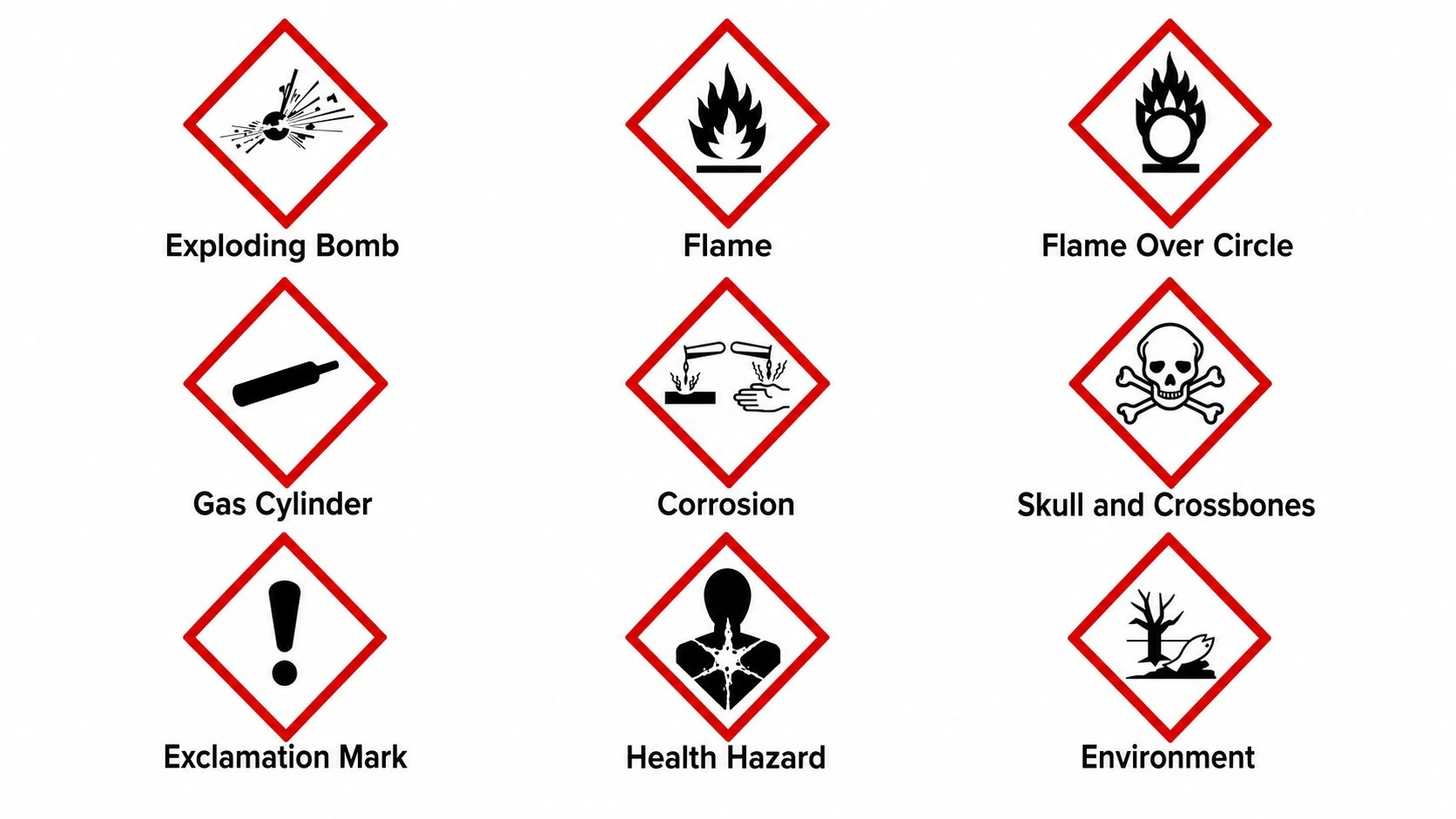
The classification of the substance under GB CLP, with the relevant hazard pictograms, signal word ("Danger" or "Warning"), hazard statements (H-statements with their three-digit codes) and precautionary statements (P-statements). Any hazards not covered by the formal classification (such as known health effects below classification thresholds) appear here too. This is the section that drives the COSHH assessment for the substance, because it's where the hazards are formally stated.
Section 3 — Composition
The ingredients of a mixture, with their CAS or EC numbers and their concentrations. For a single-substance product, the composition is straightforward; for mixtures, the supplier may indicate ranges rather than exact concentrations to protect commercial confidentiality, as long as the hazard classification can still be applied. Workers with specific allergies or sensitivities need this section to check for the relevant ingredients.
Section 4 — First-aid measures
What to do if someone is exposed to the substance by inhalation, skin contact, eye contact, or ingestion. The section also covers the symptoms to expect and any specific medical treatment that may be needed. The information here feeds directly into the workplace first-aid arrangements for the substance.
Section 5 — Fire-fighting measures
What kind of fire-extinguishing agents to use (and which not to use — water on burning sodium, for example), specific hazards from combustion, and protective equipment for fire-fighters. Where the substance can release toxic combustion products, the section identifies them. Site emergency arrangements use this information when planning fire response.
Section 6 — Accidental release measures
How to respond to a spill — what PPE to wear during clean-up, how to contain the spill, how to neutralise or absorb it, and how to dispose of the residue safely. For substances that release vapour, the section covers ventilation and area cordoning.
Section 7 — Handling and storage
How to handle the substance safely during normal use, and how to store it. For COSHH purposes, this section is critical — it usually identifies incompatible substances that must be segregated from this one, the kind of containers to use, ventilation requirements, and any temperature limits. The information feeds into COSHH storage requirements for the workplace as a whole.
Section 8 — Exposure controls and personal protection
The single most operationally important section for COSHH. It lists the workplace exposure limit (WEL) if there is one, any biological monitoring values, the engineering controls the supplier recommends, and the specific PPE — gloves with the right material and standard, respiratory protection with the right filter, eye and face protection.
Where Section 8 specifies a glove material (nitrile, butyl, neoprene, PVC), the recommendation is based on the substance's behaviour with that material. Using the wrong glove material can be worse than wearing no gloves at all — some solvents pass straight through nitrile in minutes while a worker feels fully protected.
Section 9 — Physical and chemical properties
Physical state, colour, odour, melting point, boiling point, flashpoint, autoignition temperature, density, solubility, vapour pressure. Useful for assessing how the substance will behave in the workplace — high vapour pressure means significant evaporation; low flashpoint means significant fire risk.
Section 10 — Stability and reactivity
Conditions to avoid (heat, light, water), incompatible materials, hazardous decomposition products, and any tendency to react with itself (polymerisation, decomposition). This section flags the combinations that mustn't occur — feeding the segregation plan in storage requirements.
Section 11 — Toxicological information
The health effects of the substance, structured by route of exposure (inhalation, skin contact, eye contact, ingestion). The section covers acute effects (what happens after a single exposure), chronic effects (what happens after repeated exposure), and any classifications as a carcinogen, mutagen, reproductive toxin or sensitiser. The information feeds the COSHH risk evaluation — particularly the "how it harms" element of the assessment.
Section 12 — Ecological information
The environmental effects of the substance — aquatic toxicity, persistence, bioaccumulation, mobility in soil. The information matters mainly for spill response and disposal planning.
Section 13 — Disposal considerations
How to dispose of the substance, contaminated containers and absorbed spill residues. Most hazardous substances require disposal as hazardous waste through licensed contractors. The section identifies any specific disposal codes that apply.
Section 14 — Transport information
The substance's classification for transport under ADR (road), IMDG (sea), IATA (air) and RID (rail). The transport classification can differ from the supply classification — the same substance carries different labels in transit versus at the point of use.
Section 15 — Regulatory information
References to specific regulations that apply to the substance — REACH authorisation list, controlled drug schedules, prohibited substances lists. The section is often more relevant for compliance teams than for shop-floor users.
Section 16 — Other information
The revision date of the SDS, what changed since the previous version, abbreviations used, and references to the data sources. Always check the revision date — an SDS from 2009 hasn't seen GHS at all and pre-dates much of the current regulatory landscape.
How to obtain a safety data sheet
The supplier's duty under Article 31 is to provide the SDS automatically with the first delivery of a hazardous substance, and again whenever the SDS is updated significantly. In practice, suppliers issue SDSs in several ways:
- Sent with the first delivery, in printed form
- Made available on the supplier's website for download
- Sent on request to commercial customers
- Provided in the customer's preferred format (PDF, structured XML for larger customers)
If your workplace has a substance for which you don't have an SDS, the right course of action is to request one from the supplier. The supplier has a legal duty to provide it. If they refuse, that's a regulatory breach you can refer to HSE, although in practice most legitimate suppliers will respond.
Where a substance was supplied historically and the supplier no longer exists, you may need to identify an equivalent product from a current supplier and use their SDS. Substituting in a different SDS for a non-equivalent product is risky — the controls and hazards may not match what you actually have.
Using the SDS in your COSHH assessment
The SDS is an input to a COSHH risk assessment, not a substitute for one. This is a distinction worth making explicitly because some workplaces treat the SDS as the assessment — keeping a folder of SDSs and assuming compliance follows. It doesn't.
A risk assessment is specific to your workplace, your processes and your workers. The SDS describes the substance in the abstract. The assessment takes the information from the SDS and applies it to the actual conditions of use:
- Section 2 of the SDS gives you the hazards; the assessment evaluates the risk in your context
- Section 7 gives you generic handling advice; the assessment specifies the procedure for your workplace
- Section 8 lists the controls the supplier recommends; the assessment identifies which controls you'll actually use, and whether they're sufficient
- Section 11 gives you the health effects; the assessment identifies who in your workplace is exposed and at what level
The output of the assessment is the COSHH record for the substance — see the COSHH risk assessment template for the structure. The process for getting there is in how to carry out a COSHH risk assessment.
Out-of-date SDS warning signs
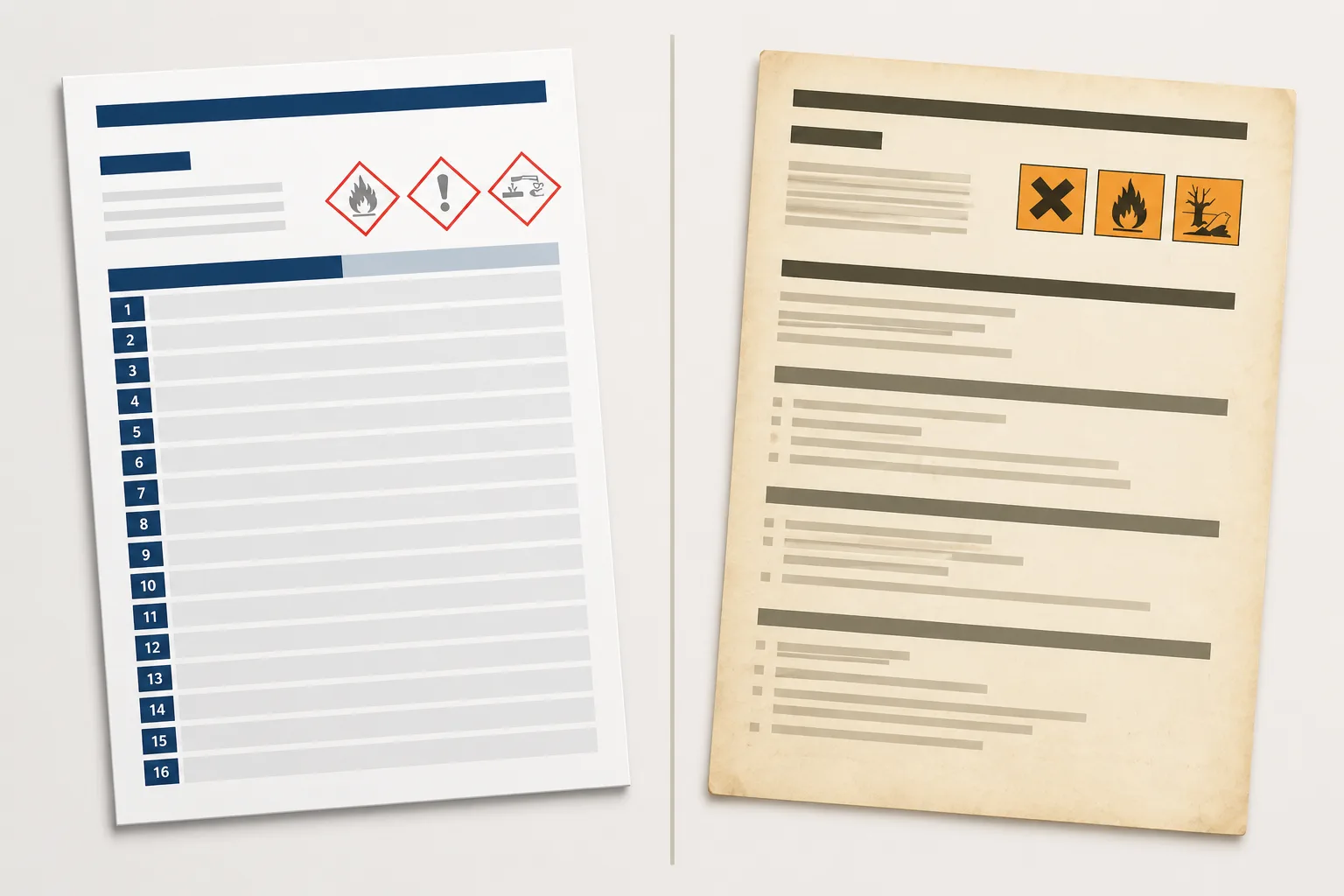
A common compliance problem in UK workplaces is operating from out-of-date safety data sheets. The substances may still be in use, but the SDS reflects a version of the regulations that no longer applies. Several signs indicate an SDS is out of date:
The document is titled "MSDS" rather than "SDS"
MSDS was the term used before GHS adoption. An MSDS pre-dates the current UK regulatory framework and probably uses outdated hazard classifications.
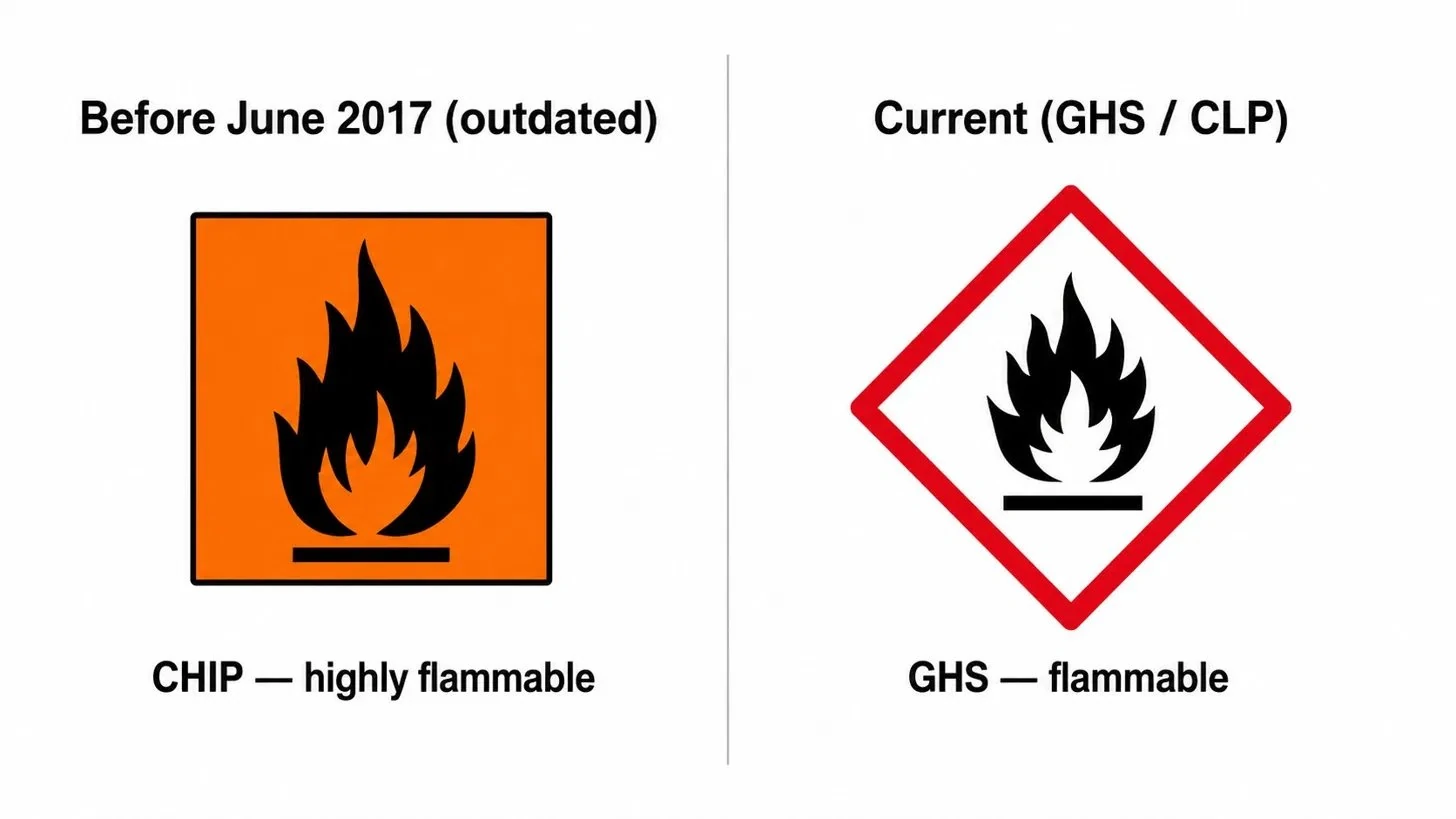
The hazard symbols are orange squares rather than red-bordered diamonds
The orange CHIP symbols were valid until June 2017. An SDS still using them is from before the current CLP regime took full effect.
The sheet references CHIPS regulations
The Chemicals (Hazard Information and Packaging for Supply) Regulations were replaced by CLP. An SDS still referencing CHIPS as the operative classification regime is out of date.
No UK REACH section
Post-Brexit SDSs supplied in the UK should reference UK REACH (or EU REACH for substances supplied to Northern Ireland). An SDS with no mention of REACH at all is likely many years out of date.
Sections aren't numbered 1 to 16
The current Annex II format has been standard since 2010. An SDS that doesn't follow the sixteen-section structure pre-dates that.
No GHS-format hazard statements (H-statements) or precautionary statements (P-statements)
These were introduced with GHS and should be present in any current SDS.
Operating from an out-of-date SDS isn't itself an offence, but it makes a proper COSHH assessment impossible. The hazards may have been reclassified, the controls updated, and the exposure limits revised. If your SDS file is more than a few years old, the right move is to request current versions from the suppliers — most will provide them immediately on request.
Worker training under Regulation 12 needs to use current information too. Training that teaches workers to recognise the old orange CHIP symbols, or refers to MSDS rather than SDS, is teaching outdated content. Structured COSHH Training uses current GHS symbols, current SDS structure and current terminology — the foundation for workers actually being able to read what they're handed.
Frequently asked questions
Is an SDS the same as a COSHH assessment?
No. The SDS describes the substance in the abstract — its hazards, properties, and recommended controls. The COSHH assessment applies that information to your specific workplace, your processes and your workers. You need both.
What's the difference between SDS and MSDS?
They refer to the same document, but MSDS is the older term. Current UK and EU regulation uses "SDS". An SDS still titled "MSDS" is likely from before GHS adoption (pre-2010) and probably out of date.
How do I get an SDS for a chemical?
Request it from the supplier. Under Article 31 of UK REACH, suppliers have a legal duty to provide an SDS for any hazardous substance they place on the market. Most modern suppliers also make SDSs available on their website.
How often must safety data sheets be updated?
Whenever significant new information becomes available — for example, a new classification, a new exposure limit, or a new known health effect. There's no fixed review period for the supplier, but a sheet that hasn't been revised in five years should be checked against the current regulatory framework.
Can I rely on the SDS without doing my own assessment?
No. The SDS gives you the substance information, but the risk depends on how the substance is used in your specific workplace — what quantities, how often, with what controls in place, and who's exposed. The assessment is the document that applies the SDS information to your context.
Related guides
- COSHH Cleaning Colour Codes Explained
- The 8 Steps to COSHH Compliance
- The COSHH Hierarchy of Control: How to Choose Controls in the Right Order
Make sure your team can read a safety data sheet and apply it under COSHH.
Explore the COSHH Training course →
Mark writes about workplace health & safety, COSHH and accredited online training for COSHH Training, part of Online CPD Academy.