%201.svg)


What the law requires for storing hazardous substances at work, what a compliant cabinet actually looks like, and how to segregate incompatible chemicals safely.
Bad chemical storage causes fires, releases vapours into workplaces, contaminates other materials, and turns ordinary chemicals into emergencies. Getting storage right is one of the more visible parts of COSHH compliance — an HSE inspector walking into a cleaning store can tell within thirty seconds whether storage is taken seriously.
This page covers what UK workplaces need to do to store hazardous substances safely and legally. The detailed cabinet specifications come from a combination of HSE guidance (HSG51), British Standards (BS EN 14470), and the Dangerous Substances and Explosive Atmospheres Regulations 2002 (DSEAR), with COSHH providing the overall framework. For the wider regulatory picture, see the COSHH regulations summary.
What COSHH actually requires for storage
A point of accuracy worth getting clear: COSHH itself doesn't prescribe specific cabinets. The regulations set outcome-based requirements through Regulation 7 (prevent or adequately control exposure), Regulation 9 (maintain control measures in efficient working order) and Regulation 13 (emergency arrangements). The specifics — what fire rating, what sump capacity, what segregation distances — come from separate guidance and standards.
This matters because some retailer pages imply that COSHH "requires" yellow cabinets or specific products. That's not how the regulations work. The legal duty is to store substances in a way that prevents harm; the cabinets, signs and procedures are the means.
The standards that fill in the practical detail are:
- HSG51 — HSE's guidance on the storage of flammable liquids in containers
- L138 — the Approved Code of Practice for DSEAR
- BS EN 14470-1 — the British and European Standard for fire-resistant cabinets for flammable liquids
- BS EN 14470-2 — the equivalent standard for gas cylinder cabinets
A compliant storage arrangement meets the relevant standards, follows HSE guidance, and is documented in the COSHH risk assessment for each substance stored.
What a compliant storage cabinet looks like

For most workplaces, a compliant storage arrangement for hazardous liquids has the following features.
Construction
Steel body with a powder-coated finish, designed to contain spillage and resist chemical attack from any substance leaked inside. Welded seams (not folded or riveted joints that can leak). Reinforced doors with a sealing strip.
Sump (bunded base)
A built-in tray at the bottom of the cabinet that contains leaks from any container above. HSG51 expects the sump to hold at least 110% of the volume of the largest single container stored inside. So a cabinet holding two 25-litre drums needs a sump that can hold 27.5 litres minimum.
Ventilation
Vents at the top and bottom of the cabinet to dissipate vapour. For most flammable liquid storage, passive ventilation is sufficient. For substances generating significant vapour or for very volatile chemicals, the cabinet may need to be connected to a mechanical ventilation system.
Locking
A keyed lock to restrict access to authorised people. Two-point locking systems are common for larger cabinets.
Signage
The relevant hazard pictograms applied to the cabinet's exterior, identifying the categories of substance stored inside. The standard signs follow the same GB CLP pictograms used on substance labels — see COSHH symbols and their meanings for the full set.
Fire rating
For flammable liquids, the cabinet should meet BS EN 14470-1 with a defined fire resistance time. The standard recognises four types: Type 15 (15 minutes), Type 30 (30 minutes), Type 60 (60 minutes), and Type 90 (90 minutes). The rating you need depends on the quantity stored, the substance volatility, and the proximity to escape routes and ignition sources.
The yellow colour you'll see on most COSHH cabinets is industry convention, not a legal requirement. Yellow has become the de facto colour for hazardous chemical storage in the UK, and the consistency is useful — workers across different sites recognise a yellow cabinet at a glance. But a cabinet that meets the construction requirements in a different colour is equally compliant.
Volume limits for flammable liquid storage
HSG51 sets practical limits on how much flammable liquid can be stored in a workroom or process area (as distinct from a dedicated chemical store):
- No more than 50 litres of extremely flammable liquids, or of flammable liquids with a flashpoint below the maximum ambient temperature of the workplace
- No more than 250 litres of other flammable liquids
These are total limits across the room, including the contents of all cabinets, dispensing containers and any open containers in use. The limits exist to keep the quantity of flammable material in a working area below the level at which a fire would be unmanageable.
Above these quantities, the substances need to go into a dedicated chemical store — a separate room or external building meeting more stringent fire-resistance and ventilation requirements. The transition from workroom storage to dedicated store is one of the questions to think about when a workplace's chemical use scales up.
Sumps and secondary containment

The sump capacity rule (110% of the largest single container) is HSG51's basis. Other guidance uses slightly different rules — some recommend 25% of total contents, on the basis that multiple containers are unlikely to all fail simultaneously. The HSG51 figure is the conservative one and the standard most HSE inspectors will check against.
For storage outside a cabinet — drums on a hard standing, IBC tanks in a chemical store — secondary containment is provided by bunded floors, drip trays or external bund walls. The same principle applies: capacity sized to contain a credible single failure, with no drains running out of the bunded area into the wider environment.
Segregating incompatible substances

Storing the wrong chemicals next to each other is one of the most common storage failures. Some combinations produce dangerous reactions if their containers fail or leak — fires, toxic gases, exothermic reactions, or splashes that worsen what could have been a contained spill.
The substances that need to be segregated fall into a few major incompatibility groups:
| Substance category | Must be kept away from | Why |
|---|---|---|
| Acids (mineral and organic) | Alkalis, oxidisers, cyanides, sulfides | Vigorous reactions, possible release of toxic gases (e.g. HCN, H₂S) |
| Alkalis (bases) | Acids, organic peroxides | Exothermic reactions |
| Oxidisers (peroxides, perchlorates, nitrates) | Flammables, organics, reducing agents | Fire and explosion risk |
| Flammable liquids | Oxidisers, ignition sources | Direct fire and explosion risk |
| Water-reactive substances (alkali metals, calcium carbide) | Water, aqueous solutions | Often spontaneous ignition or gas release |
| Toxic substances | Foods, food packaging, water supplies | Cross-contamination risk |
| Bleach (sodium hypochlorite) | Acids, ammonia, alcohols | Releases chlorine gas; with ammonia releases chloramine |
| Cyanides | Acids | Releases hydrogen cyanide gas |
The practical implementation is simpler than the table suggests. For most small workplaces, the rule is: store acids separately from alkalis, oxidisers separately from flammables and organics, bleach separately from anything acidic, and don't put toxics near food. Most workplaces achieve this with two or three separate cabinets — one for flammables, one for general chemicals, one for cleaning chemicals — and an internal rule about what goes in each.
For larger sites with more complex inventories, a formal segregation matrix is part of the safety management system. The matrix lists every substance stored on site and indicates which can be co-located. The substance safety data sheet (Section 7 — handling and storage, and Section 10 — stability and reactivity) is the source for the segregation requirements of a particular substance.
The risk assessment for each substance — see the COSHH risk assessment template for the field structure — should record the segregation requirements explicitly.
Container labelling
Substances bought in original supplier containers come with full CLP labels and don't need additional labelling. Substances decanted into smaller working containers — spray bottles, dispensing flasks, sample jars — must be labelled too. The label must identify the substance, show the hazard pictograms, and indicate the hazards. A simple printed sticker meets the requirement.
Unlabelled or poorly labelled decanted containers are one of the most common HSE findings during inspection. Workers passing through a workplace shouldn't have to guess what's in a bottle, and a cleaner finding an unlabelled container of clear liquid shouldn't have to assume it's water.
Signage at the storage location
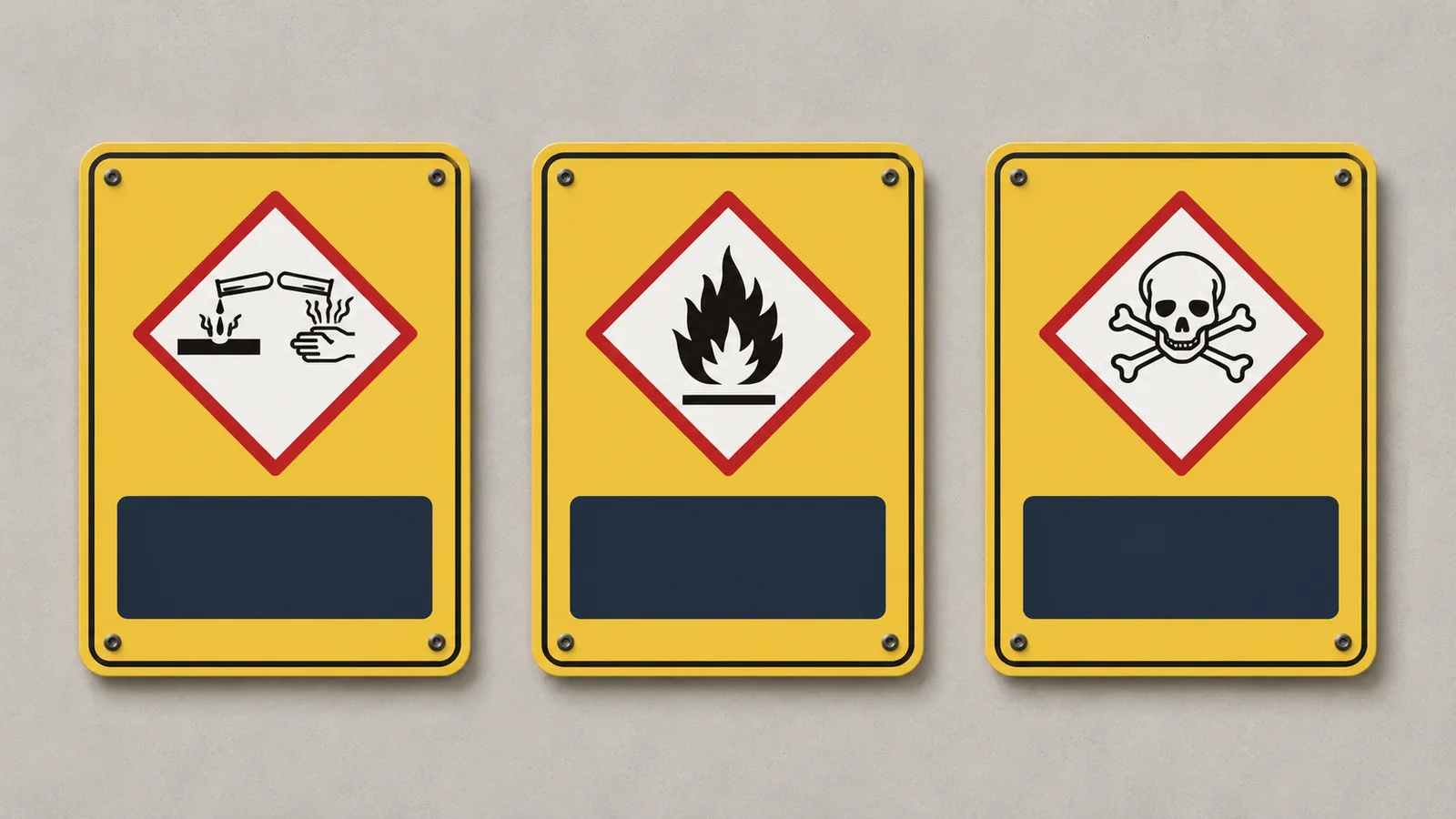
The Health and Safety (Safety Signs and Signals) Regulations 1996 require warning signs to be displayed where hazardous substances are stored or used. For COSHH cabinets and stores, the standard practice is to apply the relevant CLP pictograms to the cabinet exterior and, for larger stores, a warning sign at the entrance.
Where storage involves significant quantities of flammable liquids, additional signs are needed under DSEAR — typically a yellow triangular sign with the flame symbol, plus a "no smoking" or "no naked flames" sign as appropriate.
Siting of cabinets and stores
Where to put a COSHH cabinet matters as much as what the cabinet is. The siting rules are mostly common sense applied consistently:
- Away from ignition sources — heaters, electrical distribution boards, hot equipment
- Away from fire exits and escape routes — a substance store next to the only fire exit defeats its own purpose
- Away from high-traffic areas where a damaged cabinet could be impact-damaged
- Ventilated — a cabinet in a sealed cupboard with no air movement risks vapour build-up
- Away from food preparation, food storage and water supplies — to prevent cross-contamination
- Accessible to the people who need it — workers shouldn't be tempted to keep substances at their workstation because the cabinet is too far away
For external chemical stores, additional considerations apply: distance from buildings (separation reduces fire spread risk), distance from boundaries (and from neighbouring properties), drainage that doesn't discharge into watercourses, and security against unauthorised access.
Inspection and maintenance
Cabinets need to be inspected regularly to confirm they remain in good order. The frequency depends on the substances stored and the rate of turnover. Most workplaces operate on a monthly or quarterly inspection cycle.
The inspection checks the following:
- Door seals intact and undamaged
- Sump empty, clean and undamaged
- No leaking containers inside
- Labels on cabinet exterior still visible
- Lock working and the key controlled
- No incompatible substances inside
- No expired substances or substances no longer in use (these often accumulate)
- Substance list (or COSHH register) up to date
Where ventilation is mechanical, the ventilation system needs separate maintenance — for any local exhaust ventilation under COSHH Regulation 9, including any LEV connected to storage areas, thorough examination and testing is required at intervals not exceeding 14 months.
DSEAR alongside COSHH
For flammable substances, DSEAR applies alongside COSHH. The two regulations cover different aspects: COSHH the health risk from vapours, DSEAR the fire and explosion risk. The practical implication for storage is that you need a single risk assessment that addresses both — usually documented as a DSEAR assessment that cross-references the COSHH assessment, or vice versa.
The DSEAR assessment will consider:
- Whether the storage area could form an "explosive atmosphere" (a vapour-air mixture that could ignite)
- Sources of ignition — electrical equipment, hot surfaces, static electricity
- Zone classification (where required) — Zone 0, 1 or 2 for vapour or gas atmospheres
- Control of ignition sources through ATEX-rated equipment in classified zones
Most low-volume workplace storage doesn't reach the threshold for DSEAR zone classification, but the assessment still needs to be made and documented.
Training for workers using stored substances
Storage isn't only about cabinets and signs — it's about the workers who use the substances. Regulation 12 of COSHH requires workers to be trained on the substances they handle, including how they're stored, what segregation rules apply, and what to do if a substance is damaged, leaks or is spilled. That training is part of structured COSHH Training, which typically covers symbol recognition, segregation, and emergency response together.
The training has to be specific enough to be useful. A toolbox talk explaining that "bleach goes in the yellow cabinet" is one thing; training that explains why you never mix bleach with the limescale remover is more substantial and produces fewer near-misses.
Frequently asked questions
Does COSHH require a yellow cabinet?
No. The yellow colour is industry convention, not a legal requirement. COSHH and HSG51 require storage that prevents harm — cabinets meeting the construction, sump and ventilation requirements are compliant whether they're yellow, grey or any other colour.
What's the difference between a COSHH cabinet and a flammables cabinet?
A general COSHH cabinet stores chemicals safely, with a sump, locking, and signage. A flammables cabinet additionally meets a specific fire-resistance rating under BS EN 14470-1 (Type 15, 30, 60 or 90 minutes). A flammables cabinet is a more stringent type of COSHH cabinet; not all COSHH cabinets need to be flammables-rated.
Can I store acids and alkalis together?
Not on the same shelf or in direct contact. If a leak from each occurred simultaneously the resulting reaction would be vigorous. Acids and alkalis must be physically segregated — most workplaces use separate cabinets, or at minimum separate shelves with the acid below the alkali (so a leaking acid bottle doesn't drip onto alkali below).
How much spill containment do I need?
HSG51 sets the figure at 110% of the volume of the largest single container stored. So a cabinet containing one 25-litre drum needs a sump that can hold at least 27.5 litres.
Do COSHH cabinets need ventilation?
Most flammable liquid cabinets have passive ventilation built in — vents at the top and bottom of the cabinet to allow vapour to dissipate. Substances generating significant vapour, or large quantities of volatile chemicals, may need mechanical ventilation connected to a vent stack.
How often should I inspect a COSHH cabinet?
There's no legal interval. Most workplaces inspect monthly or quarterly, checking the door seals, sump, contents and labels. Where the cabinet has mechanical ventilation, the ventilation is subject to the 14-month LEV thorough examination requirement under Regulation 9 of COSHH.