%201.svg)


A practical guide to what a good COSHH risk assessment template contains, with a field-by-field walkthrough and a worked example you can adapt.
A COSHH risk assessment template is the structured form you fill in to record your assessment of a hazardous substance. The Control of Substances Hazardous to Health Regulations 2002 don't prescribe a specific template — they require the assessment to be "suitable and sufficient" and, where the employer has five or more workers, in writing. The form is up to you, as long as the content covers everything the regulations need.
This page explains what a good template includes, walks through each field, and gives a worked example you can adapt. If you need the process for filling it in, see how to carry out a COSHH risk assessment. For the broader picture on what COSHH covers, see what COSHH is.
You can download our COSHH risk assessment template here.
What a good template needs to contain
A COSHH risk assessment template needs to do four jobs at once. It has to identify the substance, evaluate the risk, record the controls, and be auditable as evidence of compliance. Each of those drives specific fields on the form.
The mandatory content comes from Regulation 6(4): the assessment must record the "significant findings" — meaning the conclusions, the rationale, and the controls, not every minor detail considered along the way.
The practical content goes further. A template recording only the minimum is hard to use day-to-day. One that captures the supplier, batch reference, storage location, emergency response and review date is more useful to supervisors and workers, and gives a defensible audit trail.
Field-by-field walkthrough
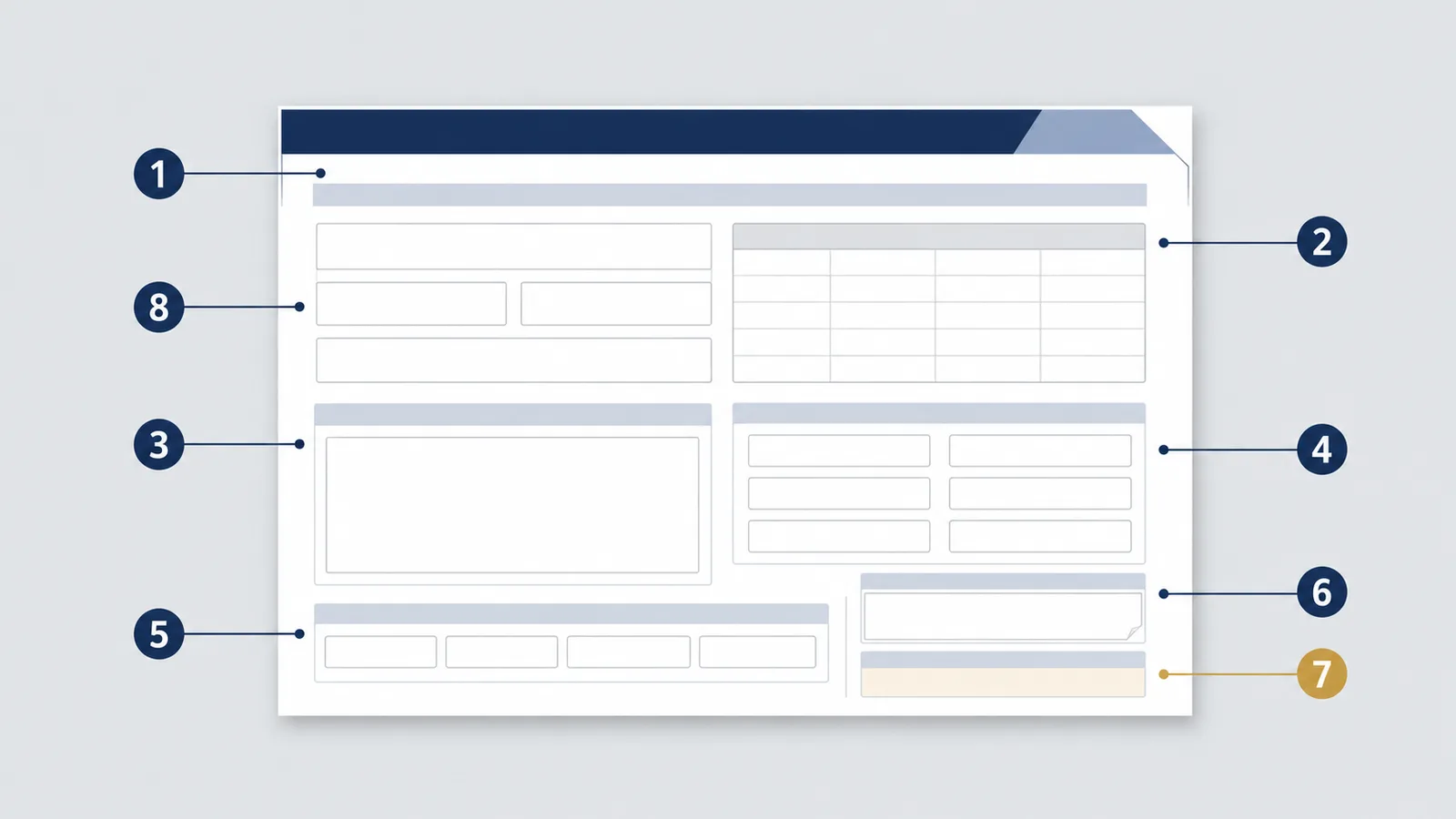
A good COSHH risk assessment template typically has the following fields, organised in roughly the order you fill them in.
Substance identification
The product name as it appears on the supplier label, plus any internal reference number, the supplier's name and contact details, and the date of the safety data sheet you're working from. The SDS reference matters because safety data sheets are revised periodically — citing the version you used tells future reviewers whether their version is more recent.
Substance description and use
A short paragraph saying what the substance is (oxidising liquid, organic solvent, biological agent) and what it's used for in your workplace. This grounds the assessment in your specific context rather than a generic chemical description.
Hazard classification
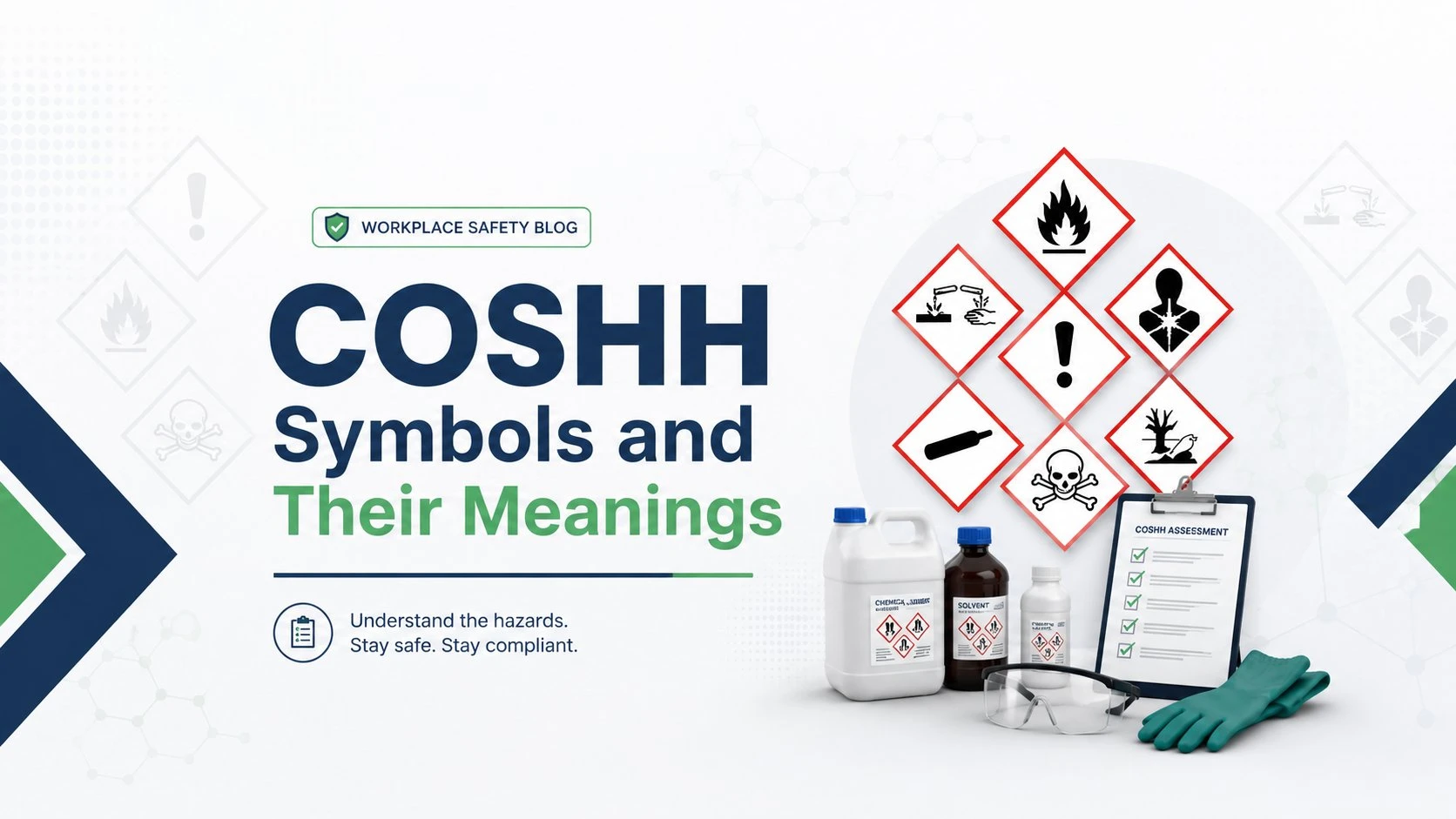
The CLP hazard pictograms that apply, copied across from Section 2 of the safety data sheet. Nine pictograms can appear: explosive, flammable, oxidising, gas under pressure, corrosive, acute toxicity, health hazard, serious health hazard, and environmental hazard. COSHH symbols and their meanings covers each one. The signal word ("Danger" or "Warning") goes here too, along with the H-statements (hazard statements like H315 "causes skin irritation") that summarise the specific hazards in standardised wording.
Workplace exposure limit (WEL)
If the substance has a WEL listed in HSE's EH40 publication, record both the 8-hour time-weighted average (TWA) and the 15-minute short-term exposure limit (STEL), if it has one. If no WEL exists, note "no WEL — control as low as reasonably practicable". This is one of the most operationally important fields because the WEL is the legal threshold against which monitoring results are judged.
Quantities and frequency of use
How much of the substance is used, how often, and over what period. "200ml per shift, daily" is more useful than "small amounts". This drives the exposure assessment in the next section.
Who is exposed
Job roles or named individuals (depending on workplace size). Note any vulnerable groups — pregnant or breastfeeding workers, young workers under 18, workers with relevant medical conditions. Include indirect exposures: cleaners, maintenance staff, members of the public where relevant.
Routes of exposure
Inhalation, skin contact, eye contact, ingestion, injection or puncture. Tick the applicable boxes and note the most significant route for this substance and use. This drives the control selection.
Level of exposure and risk evaluation
A judgement on how much exposure is likely under current conditions, and whether that's adequately controlled. Use whichever scale your organisation works to — many use a simple low/medium/high rating. The judgement is for the substance as actually used in your workplace, not the substance in the abstract.
Existing control measures
What's already in place: engineering controls (LEV, enclosure), organisational controls (procedures, restricted access, supervision), PPE issued. Be specific. "Gloves provided" is weaker than "Nitrile chemical-resistant gloves (BS EN ISO 374-1 Type A) issued; replaced when contaminated".
Additional controls required
Where existing controls aren't adequate, what needs to be added. This is the action plan. Include who's responsible, what they're going to do, and by when.
Storage and handling requirements
Where the substance is stored, in what kind of container, with what segregation from incompatible substances. Many assessments link out to a separate site storage plan. For the specifics on cabinets and segregation, see COSHH storage requirements.
Emergency arrangements
What to do if there's a spill, an exposure, or an emergency. Include first aid measures (from Section 4 of the SDS), spill response (Section 6), and fire response (Section 5) where relevant.
Health surveillance
Whether the substance triggers a health surveillance requirement under Regulation 11 — for example, work with respiratory sensitisers (occupational asthma surveillance), work with skin sensitisers in high-risk industries (dermatitis surveillance), or work with specific substances listed in Schedule 6 of COSHH.
Training requirements
What workers need to be trained on for this substance — recognition of the symbols, how to use the controls, what to do in an emergency. Workers can't be expected to comply with controls they haven't been trained on.
Review information
The date of the assessment, who carried it out (name and role), the planned next review date, and triggers that would prompt an earlier review.
A worked example

The annotated example below shows how the fields work together for a specific substance — a chlorine-based bleach used by a small cleaning company. The dates and references are illustrative.
Substance: Domestic-strength sodium hypochlorite solution, supplied as "Brand X Thick Bleach", 5L containers. Supplier reference 12345. SDS dated 14 February 2024.
Description and use: Sodium hypochlorite solution (3–5% available chlorine), used for sanitising toilets and washroom surfaces. Decanted into 750ml trigger-spray bottles for application.
Hazard classification: GHS05 (corrosive), GHS09 (environmental hazard). Signal word: Danger. H-statements: H314 (causes severe skin burns and eye damage), H400 (very toxic to aquatic life).
WEL: No WEL applies to sodium hypochlorite as supplied. Chlorine gas (the release hazard) has a STEL of 0.5 ppm.
Quantities and frequency: Approximately 750ml used per cleaner per shift, applied to surfaces in toilets and washrooms. Used Monday to Friday.
Who is exposed: Cleaning operatives directly. Building occupants secondary (exposure to residual vapour after cleaning). Members of the public in retail premises during opening hours.
Routes of exposure: Primary — skin contact, eye contact (from splashes). Secondary — inhalation of vapour, particularly in enclosed toilets.
Risk evaluation: Medium. The substance is corrosive, exposure is daily, and ventilation in many client toilets is poor. Existing controls reduce but do not eliminate the risk.
Existing controls: Pre-diluted product supplied (no concentrate handling), nitrile gloves (BS EN ISO 374-1) issued to all cleaners, eye protection available, written procedure prohibits mixing with any other product.
Additional controls required: (a) Vapour mask (BS EN 405 FFP2 with chlorine valve) to be issued for use in enclosed toilets without opening windows — by 30 June. (b) Toolbox talk on "never mix bleach with descaler" delivered to all cleaners — completed by 15 May. (c) Doors to be kept open during application wherever possible. Owner: site supervisor.
Storage: 5L containers stored in locked metal cabinet in dedicated cleaning store. Segregated from acidic descaling products (minimum two shelf separation, with a written separation rule).
Emergency arrangements: Skin contact — flush with running water for 15 minutes, seek medical attention if irritation persists. Eye contact — irrigate with water for 15 minutes minimum, seek medical attention. Spill — absorb with neutralising compound from spill kit; do not mix with acid-based absorbents. Mixing with acid by mistake — evacuate area, ventilate, do not attempt to clean up directly.
Health surveillance: Skin observation for cleaners showing repeated minor dermatitis. Formal health surveillance not required for this substance.
Training requirements: All cleaners must complete induction training including identification of CLP pictograms, correct PPE use, and the mixing prohibition. Annual refresher.
Assessor: John Smith, Site Supervisor. Assessment date: 12 March 2024. Next review: 12 March 2025, or sooner if product or process changes.
This example fits on a single A4 sheet when formatted as a form. That's the right kind of density — substantial enough to be useful, short enough that supervisors actually read it.
The COSHH register
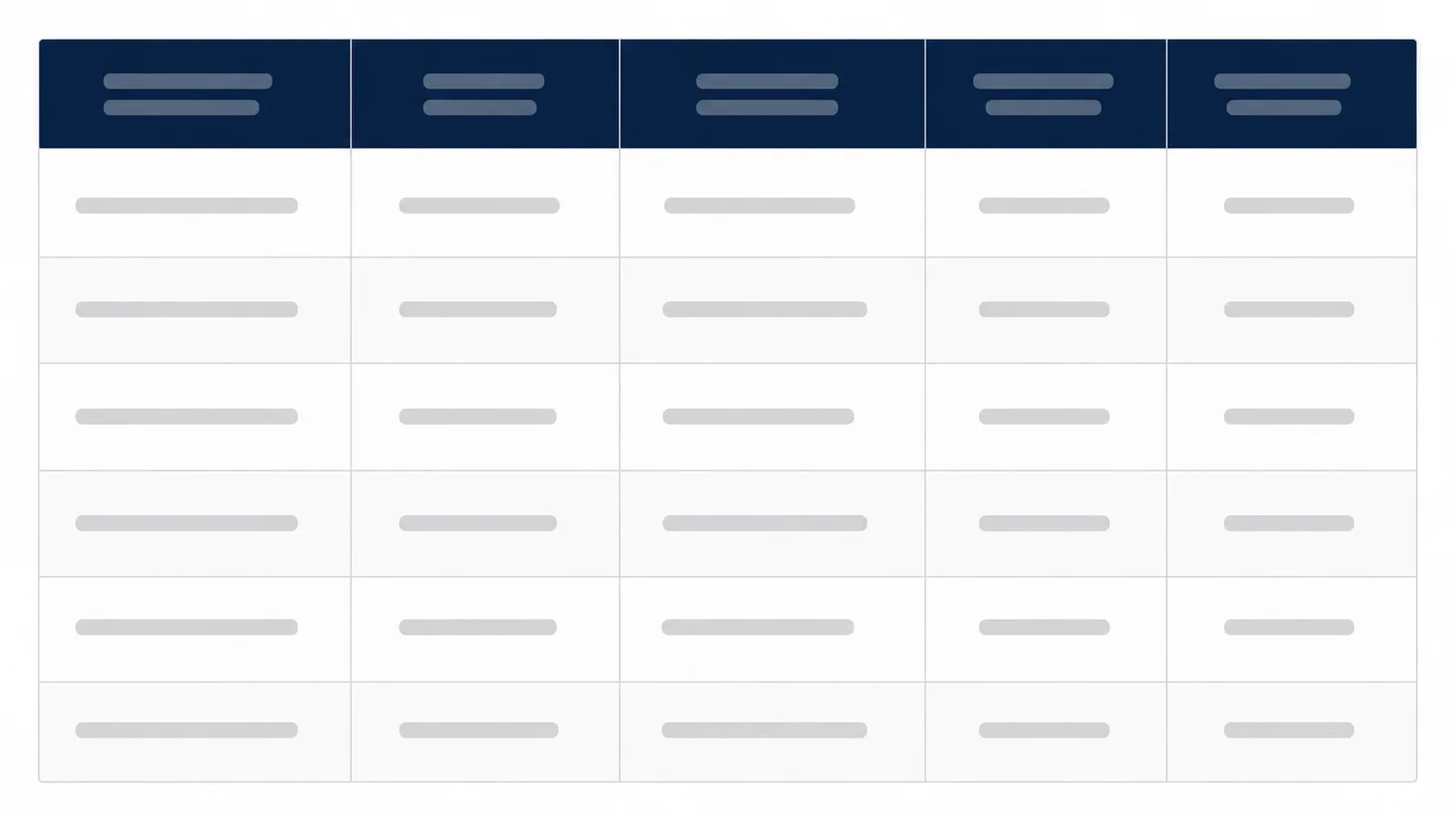
The COSHH register is a related but distinct document. Where the risk assessment covers one substance (or one closely related group), the register is the index of every hazardous substance in the workplace. It typically lists the substance name, supplier, location, quantity, the date of the corresponding risk assessment and the date of the safety data sheet. The register is what an HSE inspector asks for first, because it tells them at a glance how many substances are in scope and whether each has been assessed.
The register and the individual assessments work together. The register tells you what substances you've got; the assessments tell you what to do with each one. Some businesses combine them into a single substance-by-substance document; others keep them separate. Either is acceptable so long as the information is complete.
Retention requirements
Risk assessments should be kept current and accessible while the substance is in use, with the previous version held for a year after each update as evidence of historical practice.
Exposure monitoring records (under Regulation 10) must be kept for at least five years, or 40 years where the record relates to the personal exposure of an identifiable employee subject to health surveillance.
Health surveillance records must be kept for 40 years from the date of the last entry, under Regulation 11. The long retention period reflects the latency of occupational diseases — many take decades to manifest, and without long-retained records the link to historical exposure can't be established.
Most employers keep all COSHH-related records together — assessments, monitoring records, training records and health surveillance records — and apply the longest applicable retention period (40 years) as the working standard.
Where to get a template
You can build your own from the fields above, adapt a public template (HSE's COSHH Essentials tool produces substance-specific control sheets that work as a starting point), or use a sector-specific template from a trade association. The right template fits your work — a template designed for a chemical plant is poorly suited to a hair salon and vice versa.
Here's a template we built that you can use.
The most common compliance failure isn't an absent template; it's one filled in when the substance was first introduced and never reviewed. Building the review cycle into the template — a clear next-review date, a clear owner, a calendar reminder — is the most effective way to keep the assessment alive. Workers using the template need training on how to read it under the Regulation 12 training duty, which is one of the topics covered in structured COSHH Training.
Frequently asked questions
Is the template legally compliant?
The template itself isn't what makes you compliant — the content of the completed assessment is. The COSHH regulations don't prescribe a form. Any template that captures the substances, hazards, exposed persons, controls, emergency arrangements and review information will meet the requirements of Regulation 6(4).
Can I edit a template I've downloaded?
Yes. The structure and fields are for your benefit. Adapt them to your work — add fields you need, remove fields that don't apply. The content is what matters, not the format.
Do I need to use HSE's template?
No. HSE provides templates as examples but using them isn't a legal requirement. Your own template, a commercial template, or a sector-specific template are all acceptable provided they cover the required content.
Is the COSHH register the same as the COSHH assessment?
No. The register is an index of every hazardous substance in your workplace. The assessment is the detailed evaluation of risk for each substance (or substance group). The register points to the assessments; the assessments tell you what to do.