
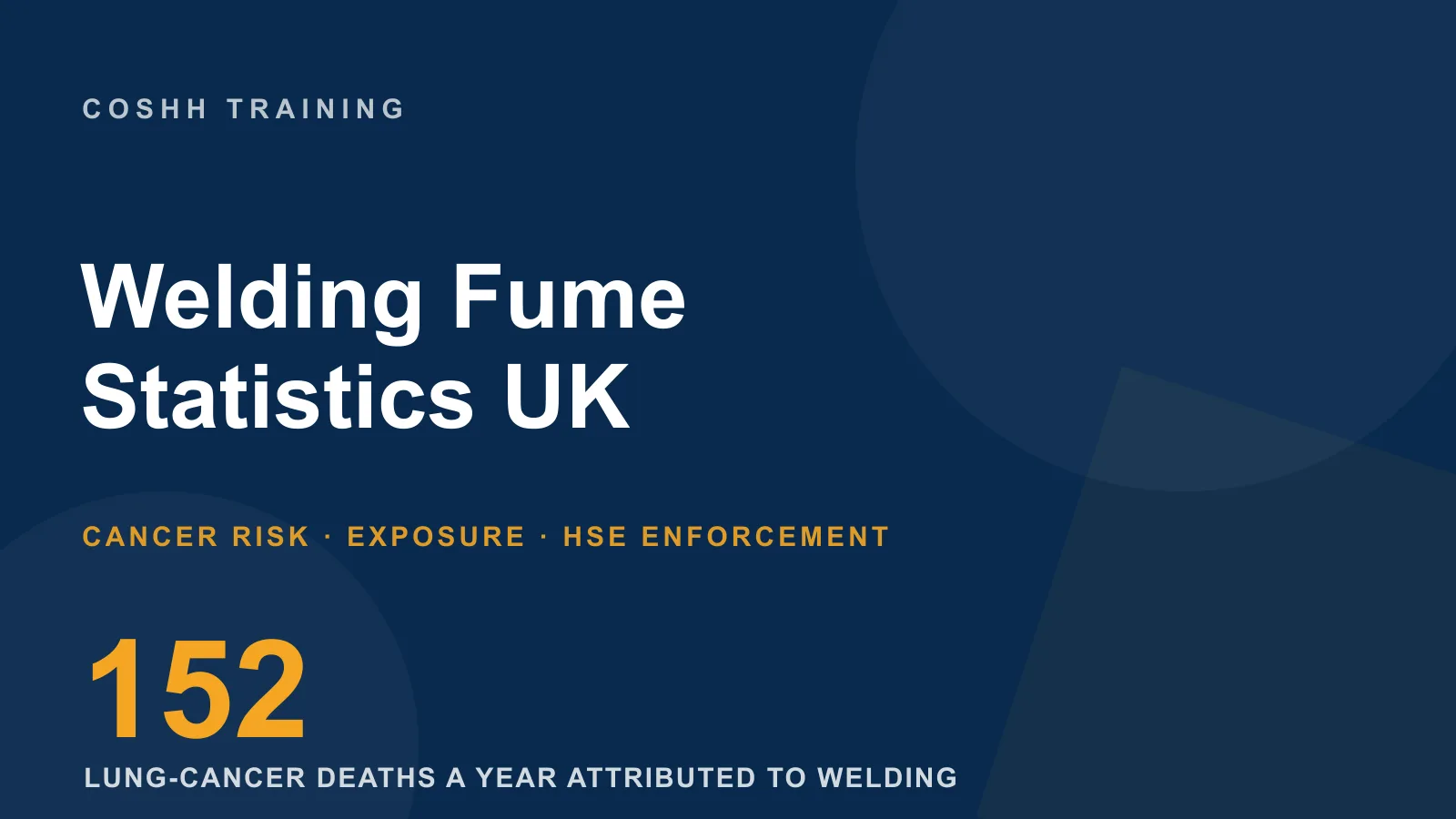
Welding causes an estimated 152 lung cancer deaths a year in Britain, and around 200,000 UK welders now face a fume that has been reclassified as a definite human carcinogen. The key UK welding fume statistics for 2026.
Welding fume was once treated as a nuisance dust. Since 2017 it has been a Group 1 carcinogen, and since February 2019 the Health and Safety Executive (HSE) has required exposure controls for all indoor welding — including mild steel — regardless of duration. This page gathers the scattered numbers behind that enforcement stance in one place: how many welders there are, how many die, what the fume does to the lungs, and where the exposure limits sit. The figures are drawn from HSE guidance and its 2019 safety bulletin, the International Agency for Research on Cancer (IARC), HSE-funded occupational cancer burden research, and the WHO/ILO Joint Estimates.
Key facts and figures
- ~200,000 welders work in the UK, roughly 40% of them as professional welders and the rest welding as part of another job.
- 152 lung cancer deaths a year in Britain are attributed to welding — 138 men and 14 women (base year 2004/05).
- Group 1 — in 2017 IARC reclassified all welding fume, mild steel included, as a definite human carcinogen, up from Group 2B.
- ~175 cancer registrations a year in Britain are attributed to welding (159 men, 16 women).
- +48% — occupational welding-fume exposure raises trachea, bronchus and lung cancer risk (pooled RR 1.48) in the WHO/ILO meta-analysis.
- 40–50 welders a year are hospitalised with metal-fume fever or pneumonia from breathing metal fume.
- 0.05 mg/m³ is the respirable manganese workplace exposure limit — highly likely to be exceeded during uncontrolled welding.
- Feb 2019 — HSE requires exposure control (LEV and/or RPE) for all indoor welding, because there is no known safe level.
Figures are the latest available as of July 2026; this page is updated when new data is released — HSE publishes its annual Occupational Lung Disease statistics each autumn (the 2025 release landed on 20 November 2025), and the occupational cancer burden estimates are refreshed periodically.
How many welders are there in the UK?
Around 200,000 people weld in the UK, according to the Institute of Occupational Medicine (IOM). Roughly 40% of them are professional welders for whom welding is the core of the job; the remaining ~60% weld as one task among many — maintenance fitters, fabricators, agricultural engineers, vehicle technicians and construction trades who pick up a torch when the work demands it. That second group matters for exposure control, because occasional welders are the ones most likely to weld without local exhaust ventilation, assuming a short job is a safe job.
The global scale puts the UK figure in context. IARC estimates that around 11 million people worldwide hold the job title “welder”, and a further 110 million or so incur welding-related exposures as part of other work (IARC Monograph 118, 2017 evaluation). Welding fume is, in other words, one of the most widespread occupational carcinogens on the planet — and one of the most under-controlled, precisely because so much of the exposure happens outside dedicated welding bays.
How many people die from welding fume in the UK?
An estimated 152 lung cancer deaths a year in Britain are attributable to welding — 138 in men and 14 in women — according to the HSE-funded occupational cancer burden study led by Rushton and colleagues (British Journal of Cancer, 2012; base year 2004/05). The same research attributes around 175 cancer registrations a year to welding (159 men, 16 women). In attributable-fraction terms, welding accounts for about 0.46% of all lung cancer deaths in Britain, rising to 0.73% among men — a small share of a very large disease, which nonetheless translates into more than a hundred avoidable deaths every year.
That toll is why the British Occupational Hygiene Society (BOHS), through its Breathe Freely in Manufacturing campaign, lists welding among the top ten causes of work-related cancer in the UK. It is also why the fume is firmly a substance covered by COSHH: like silica dust, it is generated by the work itself rather than bought in a labelled container, so the hazard is easy to overlook in a COSHH risk assessment that only looks at the products on the shelf.
The lung-cancer deaths are the long-latency harm; welding fume also causes acute illness. HSE estimates that breathing metal fume at work leads to 40 to 50 welders each year being hospitalised with metal-fume fever or pneumonia, and that pneumonia kills about 2 welders a year (HSE, Health risks from welding). Welders have a markedly higher risk of pneumonia than the general working population — the reason HSE recommends the pneumococcal vaccine for those who weld regularly.
Is mild steel welding fume a carcinogen?
Yes. In 2017 IARC reclassified all welding fume — explicitly including mild steel welding fume — as a Group 1 (definite) human carcinogen that causes lung cancer, upgrading it from the Group 2B (“possibly carcinogenic”) rating it had held since 1989 (IARC Monograph 118, evaluation 2017, published 2018). The reclassification was decisive because it removed the long-standing assumption that only stainless-steel fume, with its chromium and nickel content, posed a cancer risk. IARC concluded that all welding fume causes lung cancer, whatever the base metal.
IARC went further on two related exposures. It classified the ultraviolet radiation from welding as a Group 1 carcinogen as well — a cause of ocular melanoma (melanoma of the eye) — and it noted the evidence linking welding fume to kidney cancer. The upshot is that mild steel welding, long treated as the “safe” end of the trade, carries a confirmed cancer risk of its own.
The independent epidemiology backs the classification up. The WHO/ILO Joint Estimates meta-analysis found that any or high occupational exposure to welding fume raised the incidence of trachea, bronchus and lung cancer by around 48% (pooled relative risk 1.48, 95% confidence interval 1.29–1.70), across 23 studies (Loomis et al., Environment International, 2022). A relative risk of 1.48 means welders in these studies were roughly one-and-a-half times as likely to develop lung cancer as comparable non-exposed workers.
A point of scope worth being clear about: the hexavalent chromium and nickel in stainless-steel fume are carcinogens in their own right, but the cancer risk described here applies to the fume as a whole, mild steel included. Cr(VI) as a substance across all its exposure routes is a topic of its own and is not covered on this page.
Welding fume statistics at a glance
The table below summarises the headline UK measures and where each one currently stands.
| Measure | Latest figure | Period / source |
|---|---|---|
| Welders in the UK | ~200,000 (~40% professional) | Current, IOM |
| Lung cancer deaths attributed to welding (GB) | 152 a year (138 M, 14 F) | Base year 2004/05, Rushton et al. 2012 |
| Cancer registrations attributed to welding (GB) | ~175 a year (159 M, 16 F) | Base year 2004/05, Rushton et al. 2012 |
| Share of all GB lung cancer deaths | ~0.46% (0.73% in men) | Rushton et al. 2012 |
| Increase in lung cancer risk from exposure | +48% (RR 1.48, 23 studies) | WHO/ILO Joint Estimates, 2022 |
| Welders hospitalised with metal-fume fever / pneumonia | 40–50 a year | Current, HSE |
| Deaths from pneumonia in welders | ~2 a year | Current, HSE |
| Respirable manganese workplace exposure limit | 0.05 mg/m³ (8-hour TWA) | Current, HSE EH40 |
| IARC classification of welding fume | Group 1 (definite carcinogen) | 2017 evaluation |
What is metal-fume fever, and how common is it?
40 to 50 welders a year are hospitalised in Great Britain with metal-fume fever or pneumonia after breathing metal fume, and pneumonia kills around 2 welders a year (HSE, Health risks from welding). Metal-fume fever — sometimes called “the welder’s flu” or “Monday fever” — is an acute, flu-like reaction most often linked to freshly formed zinc oxide fume, typically from welding or cutting galvanised steel. Symptoms come on hours after exposure: fever, chills, aching muscles, a metallic taste and a dry cough, usually resolving within a day or two.
The condition is frequently dismissed as a genuine winter cold precisely because it mimics one, which means the true incidence is almost certainly higher than the hospitalisation count suggests — most episodes never reach a hospital. It matters beyond the discomfort of a bad afternoon: repeated exposure signals that fume control is inadequate, and the same uncontrolled fume that triggers a fever this week is delivering the metals behind the long-latency cancer and lung-function harm over a career. Metal-fume fever is, in effect, an early warning light on the dashboard.
What is the exposure limit for welding fume?
There is no single workplace exposure limit (WEL) for “welding fume” as a whole; instead the fume is controlled through the limits on its individual components and, since 2019, through a blanket HSE enforcement expectation. The most quoted component limit is for respirable manganese, set at 0.05 mg/m³ as an 8-hour time-weighted average in HSE’s EH40 — a level HSE warns is highly likely to be exceeded during uncontrolled welding. Manganese is present in the fume from ordinary mild-steel welding and, at excessive exposure, is linked to neurological (Parkinson-like) effects as well as respiratory harm.
Because welding fume is a carcinogen, the COSHH Regulations 2002 require exposure to be reduced as low as reasonably practicable — not merely kept below any single component limit. In practice that means capturing the fume at source with local exhaust ventilation (LEV), positioning the welder to keep their head out of the plume, and providing suitable respiratory protective equipment (RPE) as a supplement rather than a substitute. It is a textbook application of the COSHH hierarchy of control, with engineering controls ahead of PPE.
What does HSE require for welding fume?
Since February 2019, HSE has required suitable exposure control — LEV and/or RPE — for all welding carried out indoors, regardless of duration, and expects effective control for outdoor welding too (HSE safety bulletin STSU1-2019). The change followed the IARC reclassification and reflects a simple conclusion: general ventilation alone does not achieve adequate control of welding fume, and there is no known safe level of exposure. In HSE’s words, the enforcement expectation applies whatever the material being welded and however brief the job.
This closed a long-standing loophole. Under the previous position, a quick weld on mild steel was widely assumed to need no fume control at all. Post-2019, HSE inspectors expect to see engineering controls in place for any indoor welding — a “two-minute job” on mild steel is no longer a defence. BOHS’s Breathe Freely in Manufacturing campaign was built to help employers meet exactly this expectation, providing practical guidance on selecting and using LEV and RPE. For any welding operation, the compliant starting point is the same as for any hazardous substance: a suitable and sufficient COSHH risk assessment covering the fume the work creates.
How does welding fit the wider lung-disease picture?
Welding is one thread in a much larger tapestry of work-related respiratory harm. HSE estimates that around 11,000 lung-disease deaths each year in Great Britain are linked to past workplace exposures across all agents — of which roughly 35% are chronic obstructive pulmonary disease (COPD), 23% non-asbestos lung cancer, 20% asbestos-related lung cancer and 20% mesothelioma (HSE Occupational Lung Disease statistics, published 20 November 2025). Separately, around 22,000 new cases a year of breathing or lung problems are self-reported as caused or made worse by work (Labour Force Survey three-year average, 2022/23–2024/25).
Welding’s 152 attributed lung-cancer deaths sit inside that 23% non-asbestos lung-cancer slice, alongside silica and other fume and dust exposures. Asbestos remains by far the largest single occupational lung-disease killer in Britain, but asbestos is a separate substance with its own dedicated resource — asbestos awareness training covers that risk. The point of setting welding beside the total is proportion, not competition: welding is a meaningful, avoidable contributor to a burden of occupational lung disease that still runs to five figures a year.
Frequently asked questions
How many welders are there in the UK?
Around 200,000, according to the Institute of Occupational Medicine — roughly 40% of them professional welders, with the rest welding as part of another job such as fabrication, maintenance or vehicle repair.
How many people die from welding fume exposure in the UK each year?
An estimated 152 lung cancer deaths a year in Britain are attributed to welding (138 men and 14 women), based on HSE-funded burden research with a base year of 2004/05. Welding also contributes to around 175 cancer registrations a year, and metal-fume-related pneumonia kills about 2 welders a year.
Is mild steel welding fume a carcinogen?
Yes. In 2017 IARC reclassified all welding fume, mild steel included, as a Group 1 (definite) human carcinogen that causes lung cancer — upgrading it from the Group 2B rating it had held since 1989. There is no known safe level of exposure.
What is the workplace exposure limit (WEL) for welding fume?
There is no single WEL for welding fume as a whole; it is controlled through limits on its components and a blanket HSE enforcement expectation. The most quoted component limit is respirable manganese at 0.05 mg/m³ (8-hour TWA), which HSE says is highly likely to be exceeded during uncontrolled welding. As a carcinogen, welding fume must be controlled as low as reasonably practicable.
Do I need fume extraction for a quick mild steel weld?
Yes. Since February 2019 HSE has required exposure control (LEV and/or RPE) for all indoor welding regardless of duration and regardless of the material, because general ventilation does not achieve control and there is no safe level. A short job on mild steel is no longer exempt.
Related guides
- COSHH Statistics UK: Hazardous Substances at Work
- Silica Dust Statistics UK: Exposure, Silicosis & Deaths
- Occupational Asthma Statistics UK: Work-Related Lung Disease
- What Substances Are Covered by COSHH? (And What Isn’t)
- The COSHH Hierarchy of Control: How to Choose Controls in the Right Order
Sources & references
- HSE — Change in enforcement expectations for mild steel welding fume (safety bulletin STSU1-2019, February 2019)
- HSE — Health risks from welding
- HSE — Welding fume: protect your workers
- HSE — Occupational Lung Disease statistics in Great Britain, 2025
- Rushton et al. — Occupational cancer in Britain: respiratory cancer sites (British Journal of Cancer, 2012)
- IARC — Monographs Volume 118: Welding, welding fumes and some related chemicals (2017 evaluation)
- BOHS — Breathe Freely in Manufacturing (welding fume campaign)
- IOM — Welding Fumes: exposure and health evidence
- Loomis et al. — WHO/ILO Joint Estimates: welding fumes and trachea, bronchus and lung cancer (Environment International, 2022)
Welding fume is a COSHH carcinogen — make sure your team can recognise the risk and apply the right controls before the arc strikes.
Explore the COSHH Training course →
Mark writes about workplace health & safety, COSHH and accredited online training for COSHH Training, part of Online CPD Academy.