
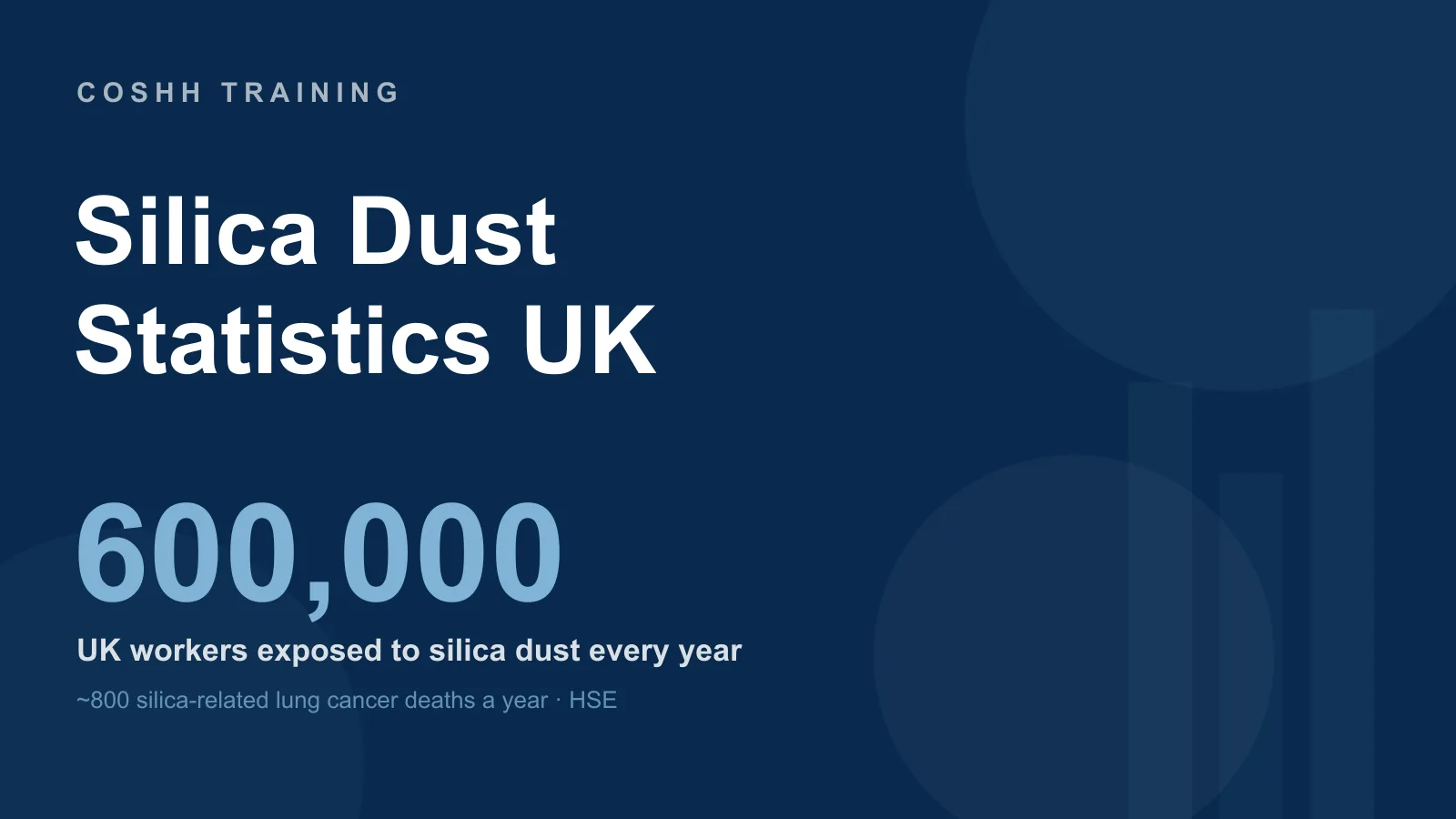
Around 600,000 UK workers are exposed to silica dust each year and about 800 die from silica-related lung cancer. The key UK silica statistics for 2026.
Respirable crystalline silica (RCS) — the fine dust released when stone, concrete, brick and mortar are cut, drilled, ground or polished — is the biggest risk to construction workers’ lungs after asbestos, and in 2026 it is under the most intense regulatory scrutiny the UK has seen. This page gathers the key UK statistics in one place: how many workers are exposed, how many die, how many silicosis cases are diagnosed each year, and what is happening with engineered stone. The figures are drawn from the Health and Safety Executive’s (HSE) annual work-related lung disease statistics, Office for National Statistics (ONS) death registrations and HSE’s 2026 enforcement programme.
Key facts and figures
- 600,000 UK workers are estimated to be exposed to respirable crystalline silica each year.
- ~800 lung cancer deaths a year in Great Britain (789 in HSE’s burden estimate) are attributed to past silica exposure at work.
- 500+ of those deaths each year are construction workers, according to HSE-commissioned research.
- 50+ confirmed UK silicosis cases have been linked to engineered stone, with at least 4 deaths as of 2026.
- 35 new silicosis and pneumoconiosis cases were assessed for Industrial Injuries Disablement Benefit in 2023, up from 25 in 2021.
- 7 deaths were provisionally registered in 2025 in England and Wales with silica pneumoconiosis as the underlying cause.
- 0.1 mg/m³ is the UK workplace exposure limit for RCS — twice the limit used in the US and Australia.
- 1,000+ HSE inspections of stone fabricators are running over the 12 months from May 2026, with dry cutting declared unacceptable.
Figures are the latest available as of July 2026; this page is updated when new data is released — HSE publishes its annual silicosis and work-related lung disease statistics each November, and ONS death registrations refresh annually.
How many UK workers are exposed to silica dust?
Around 600,000 UK workers are exposed to respirable crystalline silica each year, according to the HSE estimate cited by the British Safety Council and IOSH’s No Time to Lose campaign. Crystalline silica is a natural mineral found in stone, sand, concrete, brick and mortar; the hazard arises when work turns it into dust fine enough to reach deep into the lungs. HSE describes silica as the biggest risk to construction workers after asbestos.
Exposure is concentrated in a recognisable set of jobs: construction trades that cut, drill, chase or grind concrete, brick and stone; stonemasons and worktop fabricators; quarry workers; foundry workers; brick, tile and ceramics manufacturing; and tunnelling. Because silica dust is generated by the work itself rather than bought in a labelled container, it is one of the workplace hazards most often missed in COSHH risk assessments — there is no supplier warning label on a concrete block. It is nonetheless firmly a substance covered by COSHH, and one of the substances HSE inspectors ask about most on construction sites.
How many people die from silica dust in the UK?
An estimated 789 lung cancer deaths a year in Great Britain — roughly 800 — are attributed to past workplace exposure to respirable crystalline silica, according to HSE’s occupational cancer burden research. Within that total, HSE-commissioned research attributes over 500 lung cancer deaths a year to silica exposure in construction alone — the study was based on 2005 deaths data and remains HSE’s current published estimate. For context, HSE estimates around 12,000 lung disease deaths each year are linked to past exposures at work across all agents, so silica is one of the largest single contributors after asbestos.
Death certificates tell a much smaller story. ONS mortality data for England and Wales records 7 provisional deaths in 2025 where pneumoconiosis due to dust containing silica (ICD-10 code J62) was the underlying cause, and silicosis appears as the underlying cause of death on average around 12 times a year (ONS FOI release, 6 February 2026).
The gap between ~800 attributed deaths and ~12 registered deaths is not a contradiction — it is two different measurements. Silica-related lung cancer is clinically indistinguishable from lung cancer caused by smoking or other exposures, so it almost never appears on a death certificate as silica-related; the ~800 figure is a modelled estimate of the share of lung cancers caused by past occupational exposure. The death-registration figures count only the small number of cases where a doctor certifies silicosis itself as the cause of death. Both numbers are real; they answer different questions.
Silica dust statistics at a glance
The table below summarises the headline UK measures and where each one currently stands.
| Measure | Latest figure | Period / trend |
|---|---|---|
| Workers exposed to respirable crystalline silica | ~600,000 a year | Current HSE estimate |
| Lung cancer deaths attributed to silica (GB) | ~800 a year (789) | HSE burden estimate, current |
| Construction deaths from silica-related lung cancer | 500+ a year | HSE-commissioned research (2005 data), still cited |
| New silicosis/pneumoconiosis IIDB cases | 35 | 2023 — up from 30 in 2022 and 25 in 2021 |
| Silicosis cases reported by chest physicians (SWORD) | 12 | 2023 — down from 36 in 2022 |
| Deaths with silica pneumoconiosis as underlying cause | 7 (provisional) | 2025, England & Wales |
| Confirmed engineered-stone silicosis cases | 50+, including at least 4 deaths | As of 2026 |
| Workplace exposure limit for RCS | 0.1 mg/m³ (8-hour TWA) | Current, HSE EH40 |
How many silicosis cases are diagnosed each year?
35 new cases of silicosis and other dust-related pneumoconiosis were assessed for Industrial Injuries Disablement Benefit (IIDB) in 2023, up from 30 in 2022 and 25 in 2021 (HSE silicosis and pneumoconiosis statistics). Separately, chest physicians reported 12 new silicosis cases in 2023 through the SWORD surveillance scheme (part of the THOR network), down from 36 in 2022 — with numbers this small, year-to-year swings are normal. By the end of 2023, SWORD had recorded 6 silicosis cases specifically linked to artificial (engineered) stone.
These surveillance figures should be read honestly for what they are: undercounts. IIDB only captures workers who make a successful benefit claim; SWORD only captures cases seen by participating chest physicians. Silicosis develops over years or decades, is frequently misdiagnosed as COPD or tuberculosis, and often surfaces after workers have left the industry — so a case count in the dozens sits alongside a modelled disease burden in the hundreds of deaths a year. HSE itself treats the burden estimates, not the case counts, as the measure of the true scale of harm.
Is engineered stone the new asbestos?
More than 50 confirmed UK silicosis cases have been linked to engineered stone, with at least 4 deaths, as of 2026 (HSE and British Safety Council). Engineered stone — the quartz composite widely used for kitchen worktops — can contain up to 95% crystalline silica, far more than most natural stone, and HSE warns that exposure from fabricating it can cause silicosis “in a matter of months or years” rather than the decades typical of natural stone dust. Its May 2026 enforcement announcement followed the deaths of two young workers from silicosis in recent years.
The “next asbestos” framing is no longer just campaign language: the All-Party Parliamentary Group for Respiratory Health published an inquiry report titled Silica – the next asbestos? in late 2025, and Australia went as far as banning engineered stone outright in 2024. The UK has so far chosen enforcement over prohibition — but the comparison drives the current policy debate, because like asbestos, silica’s harm shows up years after the exposure that caused it.
The exposure mechanics explain the concern. Dry cutting engineered stone produces respirable crystalline silica exposures five to ten times higher than wet methods, according to HSE. Combine that with a material that is mostly silica by weight, and exposure that natural stone would deliver over a working lifetime is compressed into a few years — which is why the recent UK cases include young workers only a short way into their careers.
What is HSE doing about silica dust?
More than 1,000 inspection visits to stone fabricators across Great Britain are being carried out over the 12 months from May 2026, when HSE announced its engineered-stone crackdown and declared that dry cutting of engineered stone is unacceptable unless equally effective controls can be demonstrated. The inspection programme runs through 2026/27, and the first visits were already under way when the announcement was made on 11 May 2026.
Alongside the inspections, HSE published its first-ever COSHH guidance sheet specifically for engineered stone. It tells employers to switch to low-silica stone where possible, use on-tool water suppression, control the mist that wet cutting creates, provide respiratory protective equipment, and run health surveillance for exposed workers — a direct application of the COSHH hierarchy of control, with substitution first and PPE last. For any business cutting stone, concrete or brick, the practical starting point is the same as for any hazardous substance: a suitable and sufficient COSHH risk assessment covering the dust the work creates, not just the products bought in.
What is the workplace exposure limit for silica dust?
0.1 mg/m³, averaged over an 8-hour working day, is the UK workplace exposure limit (WEL) for respirable crystalline silica, listed in HSE’s EH40 publication under the COSHH Regulations 2002. That is twice the 0.05 mg/m³ limit used in the United States and Australia, which is why halving the UK limit is a live campaign demand from the British Occupational Hygiene Society (BOHS) and others.
The limit is not a licence to pollute up to it. Because respirable crystalline silica is classified as a carcinogen, COSHH requires exposure to be reduced as low as reasonably practicable — not merely kept below the WEL. In practice that means wet cutting or on-tool extraction wherever dust is generated, FFP3 respiratory protection with face-fit testing as a supplement rather than a substitute, and no dry sweeping of silica-containing dust.
Frequently asked questions
How many people die from silicosis in the UK each year?
Silicosis itself is recorded as the underlying cause of around 12 deaths a year on average in England and Wales, with 7 provisional deaths registered in 2025 (ONS). The far larger toll is indirect: HSE’s burden research attributes around 800 lung cancer deaths a year in Great Britain to past workplace silica exposure.
How many workers are exposed to silica dust in the UK?
HSE estimates around 600,000 UK workers are exposed to respirable crystalline silica each year — mainly in construction, quarrying, stone fabrication, foundries, and brick and ceramics manufacture.
What is respirable crystalline silica?
It is the very fine fraction of crystalline silica dust — small enough to penetrate deep into the lungs — created when materials such as concrete, brick, mortar, sandstone and engineered stone are cut, drilled, ground or polished. Prolonged exposure causes silicosis, lung cancer and COPD.
Is engineered stone banned in the UK?
No. Australia banned engineered stone outright in 2024, but the UK has opted for enforcement instead: since May 2026 HSE has declared dry cutting of engineered stone unacceptable, published dedicated COSHH guidance and begun a 1,000-plus inspection programme of fabricators.
Is silica dust covered by COSHH?
Yes. Respirable crystalline silica has a workplace exposure limit of 0.1 mg/m³ and is treated as a carcinogen under COSHH, so employers must assess the risk and reduce exposure as low as reasonably practicable — even though silica dust is generated by the work rather than supplied in a labelled container.
Which jobs are most at risk from silica dust?
Worktop fabricators and stonemasons working with engineered stone currently face the highest exposures, followed by construction trades that cut or drill concrete, brick and stone, quarry workers, foundry workers, and workers in brick, tile and ceramics manufacturing.
Related guides
- COSHH Statistics UK: Hazardous Substances at Work
- Occupational Dermatitis Statistics UK: Work-Related Skin Disease
- What Substances Are Covered by COSHH? (And What Isn’t)
- How to Carry Out a COSHH Risk Assessment
- The COSHH Hierarchy of Control: How to Choose Controls in the Right Order
Sources & references
- HSE — Silicosis and coal workers’ pneumoconiosis in Great Britain (annual statistics report)
- HSE — Cancer and construction: silica dust
- HSE — Work-related lung disease statistics
- HSE Media Centre — HSE says no dry cutting of engineered stone ahead of inspection crackdown (11 May 2026)
- ONS — FOI release: Deaths caused by silicosis, 2020 to 2025 (6 February 2026)
- ONS — FOI release: Silicosis diagnosis and deaths, 1980 to 2023
- BOHS — British Occupational Hygiene Society: call for immediate action to stop unnecessary silica deaths
- APPG for Respiratory Health — Silica: the next asbestos? (inquiry report)
Silica dust is a COSHH substance — make sure your team can recognise the risk and apply the right controls before the dust flies.
Explore the COSHH Training course →
Mark writes about workplace health & safety, COSHH and accredited online training for COSHH Training, part of Online CPD Academy.