
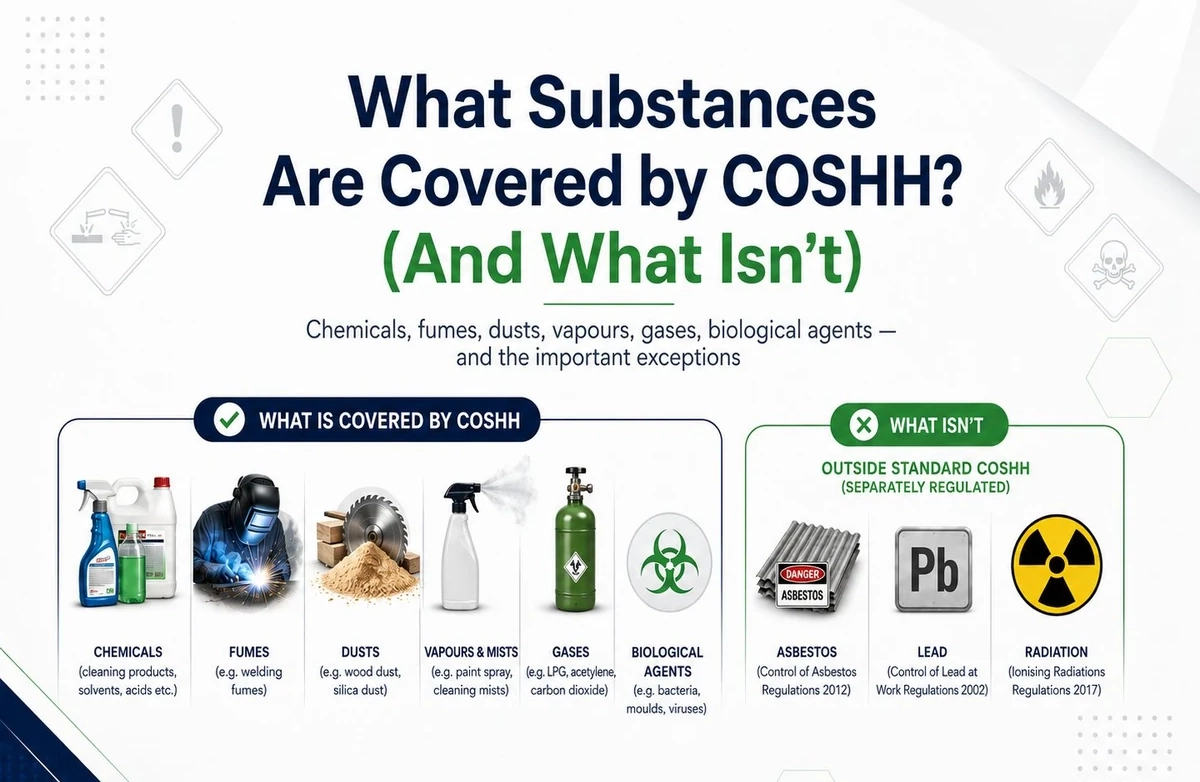
A scope guide to the Control of Substances Hazardous to Health Regulations — which substances fall under COSHH, which sit under separate regulations, and the edge cases that catch people out.
The scope of COSHH is broad. The regulations apply to almost every chemical, fume, dust, vapour, gas and biological agent used at work in the UK, and to many substances created as by-products of work processes. But three significant substance groups — asbestos, lead and radioactive substances — sit outside COSHH because they have their own dedicated regulations, and there are edge cases (nanomaterials, water, asphyxiating gases) that confuse even experienced safety practitioners.
This page covers the scope question directly. For the wider picture on COSHH, see what COSHH is. For the regulations themselves, see the COSHH Regulations 2002.
The legal definition
A "substance hazardous to health" is defined in Regulation 2 of the COSHH Regulations 2002. The definition covers four overlapping categories:
- Substances or mixtures classified as hazardous under the GB CLP Regulation
- Substances with a workplace exposure limit listed in EH40
- Biological agents
- Dust of any kind present in the air at or above the concentration limits set out in Schedule 1 of the regulations
The catch-all at the end of the definition is the one that most often surprises people: any other substance "which creates a hazard to the health of any person which is comparable with the hazards created by substances mentioned in paragraphs (a) to (e)". In other words, if it can harm health under the conditions of use, it's in scope — whether or not the supplier label says so.
What COSHH covers
In practical terms, the regulations cover the following.
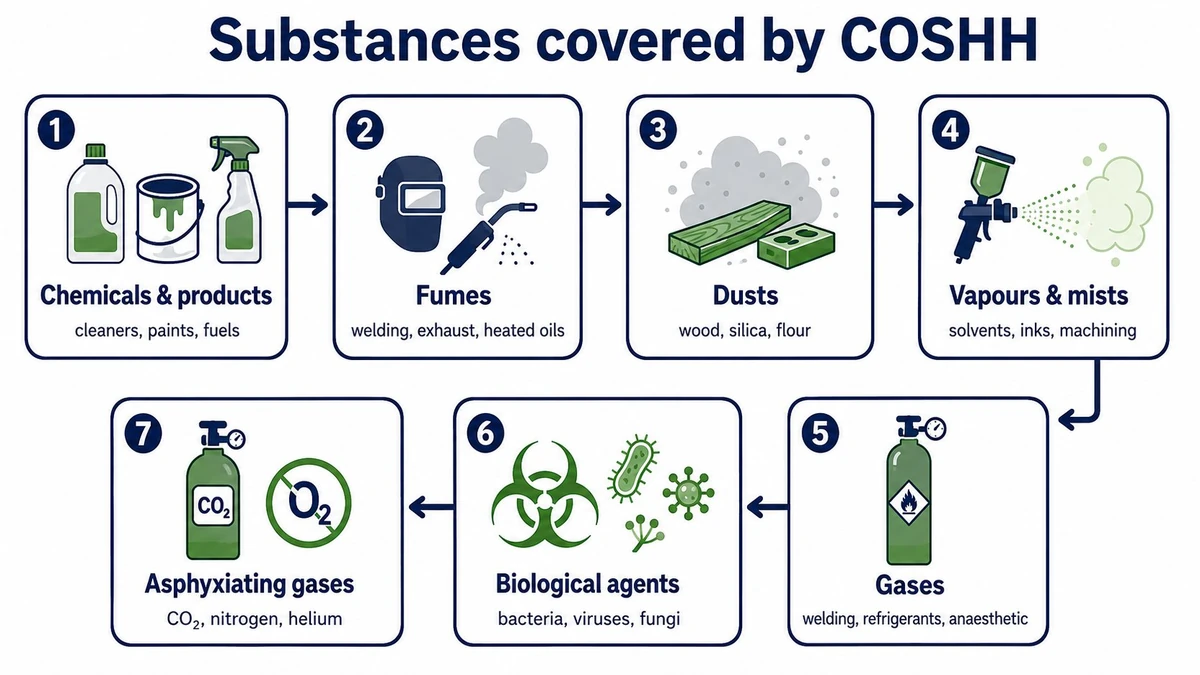
Chemicals and products containing chemicals
Cleaning products, paints, varnishes, adhesives, lubricants, fuels, pesticides, agricultural chemicals, laboratory reagents, dyes, inks, photographic chemicals, agricultural sprays. Anything bought in a container with a CLP hazard pictogram on the label is in scope; many products without a pictogram are also in scope if they have a workplace exposure limit or can cause harm in the way they're used.
Fumes
Welding fume, soldering fume, exhaust fumes from internal combustion engines used indoors, fumes from cooking oils in commercial kitchens, fumes from heated plastics. Some fumes have specific WELs; mild steel welding fume was the subject of a major HSE bulletin in 2019 reclassifying it as a category 1A carcinogen, with the practical effect that all welding now requires engineering controls (extraction) rather than PPE alone.
Dusts
Wood dust (both hardwood and softwood — hardwood is a carcinogen), silica dust from cutting or grinding stone, brick, concrete, mortar, tile or sand, flour and grain dust in food production, cement dust, plaster dust, dust from sanding paints or varnishes. Schedule 1 of COSHH sets the airborne concentration thresholds at which dust is automatically in scope: 10 mg/m³ for inhalable dust and 4 mg/m³ for respirable dust, as 8-hour time-weighted averages.
Vapours and mists
Solvent vapours from paint, glue, fuel, cleaning fluids and printing inks. Metalworking fluid mists from CNC machining and grinding. Spray mists from agricultural and horticultural spraying. Vapours from drying processes.
Gases
Industrial gases used in welding (acetylene, argon, CO₂), refrigerant gases, anaesthetic gases in healthcare, biological gases (methane from fermentation or digestion), and asphyxiating gases.
Biological agents
Bacteria, viruses, fungi, parasites and prions that can cause infection, allergy or toxicity. The regulations cover both intentional work with biological agents (laboratory cultures, vaccine production) and incidental exposure (healthcare, sewage work, agricultural work, certain manufacturing processes). Biological agents are classified into Hazard Groups 1 to 4 in Schedule 3 of the regulations, by the severity of disease they cause and the availability of effective prophylaxis.
Asphyxiating gases
Gases that displace oxygen without themselves being toxic. CO₂ in soft drink and brewery use, nitrogen in food packaging, helium in laboratory and industrial use, and inert gases used in fire suppression systems. The hazard isn't toxicity — it's that the worker doesn't notice anything wrong before losing consciousness.
What COSHH does not cover
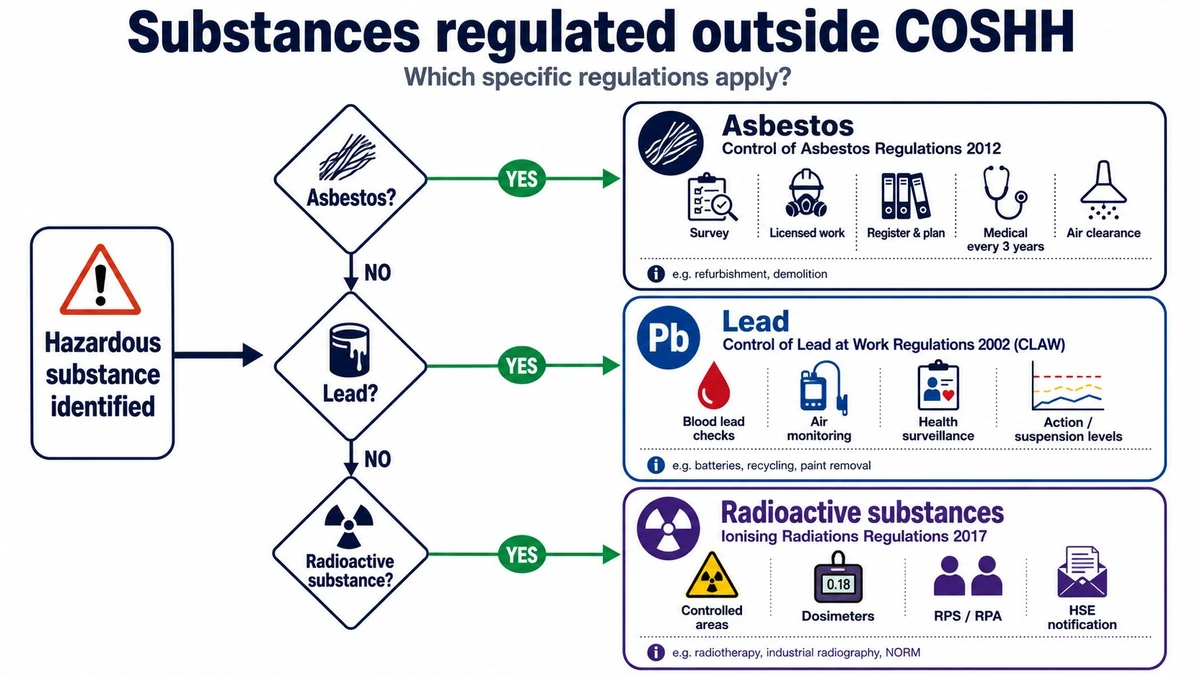
Three substance groups are outside the scope of COSHH, because each has its own dedicated regulations.
Asbestos
Asbestos is regulated by the Control of Asbestos Regulations 2012. Note the date — these are 2012 regulations, replacing earlier 2002 and 2006 regulations. A surprising number of guides still cite the older versions.
Asbestos sits outside COSHH for the same reason it has its own regulations: the controls needed for asbestos work are very different from standard COSHH controls. The 2012 regulations require duty-to-manage surveys in non-domestic premises built before 2000, licensed contractors for higher-risk work, notification of non-licensed work, medical examinations every three years for workers, asbestos register and management plan, and air clearance testing. None of this comes from COSHH.
Asbestos is the long-latency carcinogen behind mesothelioma. HSE estimates around 2,200 mesothelioma deaths a year in Great Britain — a figure that's stable but slowly declining as historical exposure works through the population.
Lead
Lead is regulated by the Control of Lead at Work Regulations 2002 (CLAW). The regulations have a similar shape to COSHH — risk assessment, prevention or control of exposure, monitoring, health surveillance — but with biological monitoring requirements that go beyond standard COSHH. Workers exposed to lead must have their blood lead levels checked periodically, with action and suspension levels set in law. The blood lead test results, not just air monitoring results, determine whether controls are adequate.
Lead exposure is mainly an issue for battery manufacturing, lead recycling, ammunition manufacture, historical paint removal, and certain ceramics and glasswork. Domestic plumbers and electricians are no longer typically exposed because lead solder for water systems has been banned since 1986 and most lead piping has been replaced.
Radioactive substances
Radioactive materials are regulated by the Ionising Radiations Regulations 2017. The duties are quite different from COSHH — they include radiation classification of work areas (controlled and supervised areas), dose monitoring with personal dosimeters, designated radiation protection supervisors and advisers, prior notification or registration with HSE, and specific protective measures.
Radioactive substances at work include radiotherapy sources in healthcare, industrial radiography sources in non-destructive testing, naturally-occurring radioactive material (NORM) in some mining and oil and gas operations, and contamination monitoring at decommissioning sites.
Substances that fall under both COSHH and DSEAR
Many flammable substances trigger both COSHH and the Dangerous Substances and Explosive Atmospheres Regulations 2002 (DSEAR). The two regulations cover different aspects of the same substance:
- COSHH covers the health risks — inhalation of vapours, skin absorption, narcotic effects
- DSEAR covers the fire and explosion risks — vapour-air mixtures forming explosive atmospheres, sources of ignition, fire spread
For most workplaces using flammable solvents (paints, white spirit, acetone, ethanol, fuels), both sets of regulations apply. The risk assessment needs to address both — usually through a combined assessment that considers health, fire and explosion together. The L138 Approved Code of Practice covers DSEAR; the L5 ACOP covers COSHH; for substances triggering both, both ACOPs are relevant.
COSHH storage requirements covers this overlap in more detail, particularly around fire-resistant storage cabinets.
The edge cases
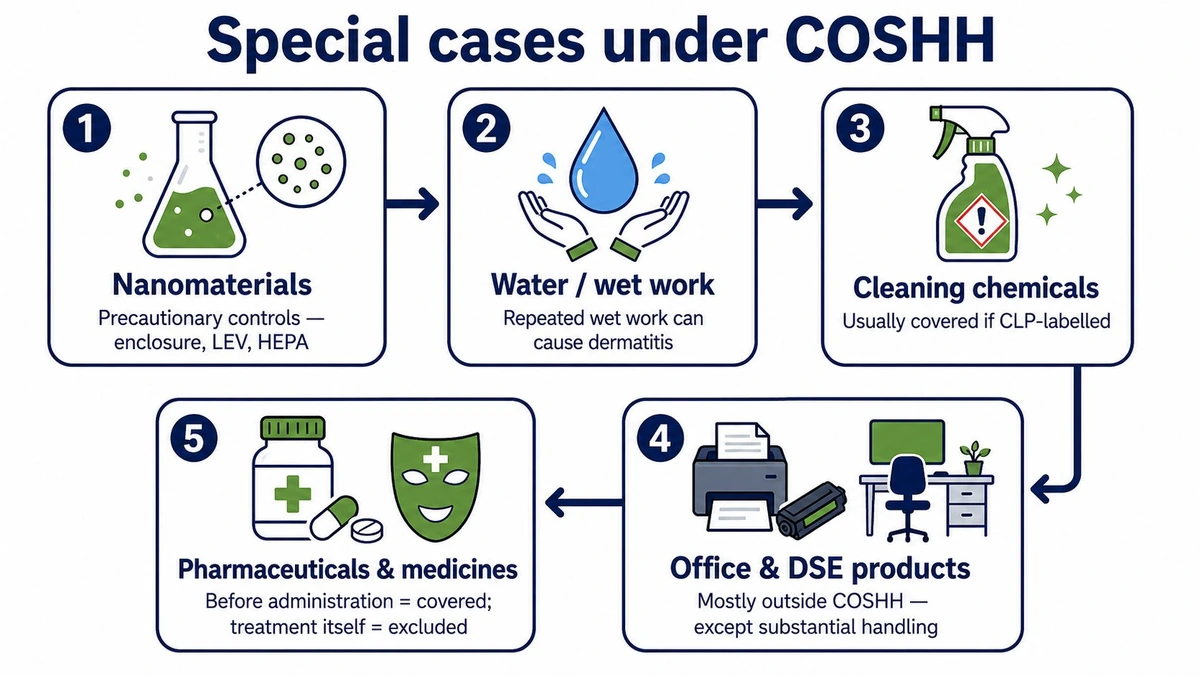
A few substance categories cause more confusion than the main rules suggest.
Nanomaterials
Nanomaterials — particles smaller than 100 nanometres in at least one dimension — are in scope of COSHH where they can harm health. HSE's position is that the substance is in scope, but exposure assessment is more difficult because conventional air sampling may not detect the relevant particles and the toxicology is still developing. For workplaces handling nanomaterials, the assessment usually has to rely on precautionary controls — enclosure, LEV with HEPA filtration, restricted access — rather than measured comparison against a WEL.
Water
Water as a substance is harmless, but prolonged contact with water at work causes occupational contact dermatitis. HSE treats wet work as a COSHH-relevant hazard where workers wash their hands or are in wet conditions repeatedly through a shift — the rule of thumb is around twenty hand-washes per day, or two-plus hours per day with wet hands, or wearing occlusive gloves for similar periods.
Healthcare, food service, catering, cleaning, hairdressing and beauty are the industries most affected. Around 84,000 people in Great Britain have work-related dermatitis at any given time, and a substantial proportion of these cases come from wet work.
Cleaning chemicals
A frequent reader question is whether cleaning products are covered by COSHH. The answer is yes for any product with a CLP hazard pictogram on the label, which covers most concentrated industrial cleaning products and many domestic-strength products too. Routine washing-up liquid and similar low-hazard products often don't carry a CLP pictogram and aren't formally in scope, although a general workplace assessment of cleaning activities is still good practice.
Office and DSE products
Office work is mostly outside COSHH because the hazardous substances involved (toner, correction fluid, photocopier emissions) are present at very low exposure levels. The exception is anyone whose role involves substantial handling — for example, photocopier engineers changing toner cartridges, or print room workers handling solvent-based cleaning chemicals. For those roles, the substances are in scope and need assessment.
Pharmaceuticals and medicines
Medicines administered to patients in healthcare are explicitly excluded from COSHH (regulation 5). COSHH covers the substances as they pass through the workplace before administration — cytotoxic drugs being prepared in pharmacy, anaesthetic gas leakage in theatre, antibiotic dust in compounding — but not the medical treatment itself. Veterinary medicine is similarly handled.
A quick scope lookup
The following table summarises the most-asked "is X covered" questions.
| Substance | In scope of COSHH? | Notes |
|---|---|---|
| Asbestos | No | Control of Asbestos Regulations 2012 |
| Lead | No | Control of Lead at Work Regulations 2002 |
| Radioactive substances | No | Ionising Radiations Regulations 2017 |
| Petrol / flammable solvents | Yes (also DSEAR) | Both health and fire risks apply |
| Cement and mortar | Yes | Chromium VI content, alkaline burns, silica dust if dry |
| Welding fume | Yes | All welding now requires engineering controls per HSE 2019 bulletin |
| Bleach (sodium hypochlorite) | Yes | Corrosive, environmental hazard |
| Biological agents | Yes | Schedule 3 hazard groups apply |
| Asphyxiating gases (CO₂, N₂) | Yes | Risk is oxygen displacement |
| Wet work (water exposure) | Yes | Where it causes dermatitis |
| Nanomaterials | Yes | With additional assessment difficulty |
| Medicines (administered to patients) | No | Explicit exclusion under Reg 5 |
| Photocopier toner (routine office use) | Generally no | Exposure too low; relevant only for handlers |
Why the boundary matters
Knowing whether a substance is in COSHH scope matters for two reasons. First, the compliance requirements differ between regimes. COSHH-style controls may be inadequate or even inappropriate for substances covered by other regulations — asbestos work needs licensing rather than just an assessment, lead work needs biological monitoring, radioactive substances need dose-based controls.
Second, the consequences of getting the boundary wrong work in both directions. Treating an in-scope substance as out of scope leaves you in breach of COSHH. Treating an out-of-scope substance as in scope (typically asbestos or lead) often means the work is being done without the more specific controls those substances need — which can be a more serious breach than the equivalent COSHH oversight.
For most workplaces, the rule of thumb is simple. If the substance carries a CLP hazard pictogram, has a WEL in EH40, is a biological agent, or generates dust in significant concentrations, assume it's in scope of COSHH and produce a risk assessment. Then check whether it falls into one of the three excluded groups — asbestos, lead, or radioactive — and if so, switch to the relevant regime.
For workers, knowing which substances they handle are in scope of COSHH and which carry more stringent regimes is part of the Regulation 12 training duty. That's where COSHH Training earns its place: practical recognition of substances and their applicable regimes is hard to get from a single induction document.
Frequently asked questions
Is lead covered by COSHH?
No. Lead at work is regulated by the Control of Lead at Work Regulations 2002, which require biological monitoring (blood lead testing) and other specific controls that COSHH doesn't include.
Is asbestos covered by COSHH?
No. Asbestos is regulated by the Control of Asbestos Regulations 2012. Asbestos work often requires licensing and specific medical surveillance — neither of which COSHH covers.
Does COSHH cover nanomaterials?
Yes, where they can harm health. The assessment is harder than for conventional substances because measurement techniques are less mature and toxicological data is more limited.
Are biological agents covered by COSHH?
Yes. Biological agents (bacteria, viruses, fungi, parasites and prions) are explicitly within scope of COSHH, classified into four hazard groups in Schedule 3 of the regulations by severity of disease and availability of effective prophylaxis.
Is bleach covered by COSHH?
Yes. Sodium hypochlorite bleach carries the GHS05 corrosive pictogram and is hazardous to health on skin contact, eye contact, and through inhalation of chlorine vapour.
Is water covered by COSHH?
Water itself isn't hazardous, but prolonged wet work (twenty-plus hand-washes per day, extended glove use, wet hands for hours) causes occupational contact dermatitis. The wet-work risk is in scope of COSHH.
What about radioactive substances?
Outside COSHH. Regulated by the Ionising Radiations Regulations 2017, which use dose-based controls and require designated radiation protection arrangements.
Is petrol covered by COSHH?
Yes for the health risks (vapour exposure, skin contact). Petrol is also covered by DSEAR for the fire and explosion risks. Most workplaces using petrol need both assessments.
Related guides
- COSHH Cleaning Colour Codes Explained
- The 8 Steps to COSHH Compliance
- The COSHH Hierarchy of Control: How to Choose Controls in the Right Order
Make sure your team is trained to recognise and work safely with substances hazardous to health.
Explore the COSHH Training course →
Mark writes about workplace health & safety, COSHH and accredited online training for COSHH Training, part of Online CPD Academy.