
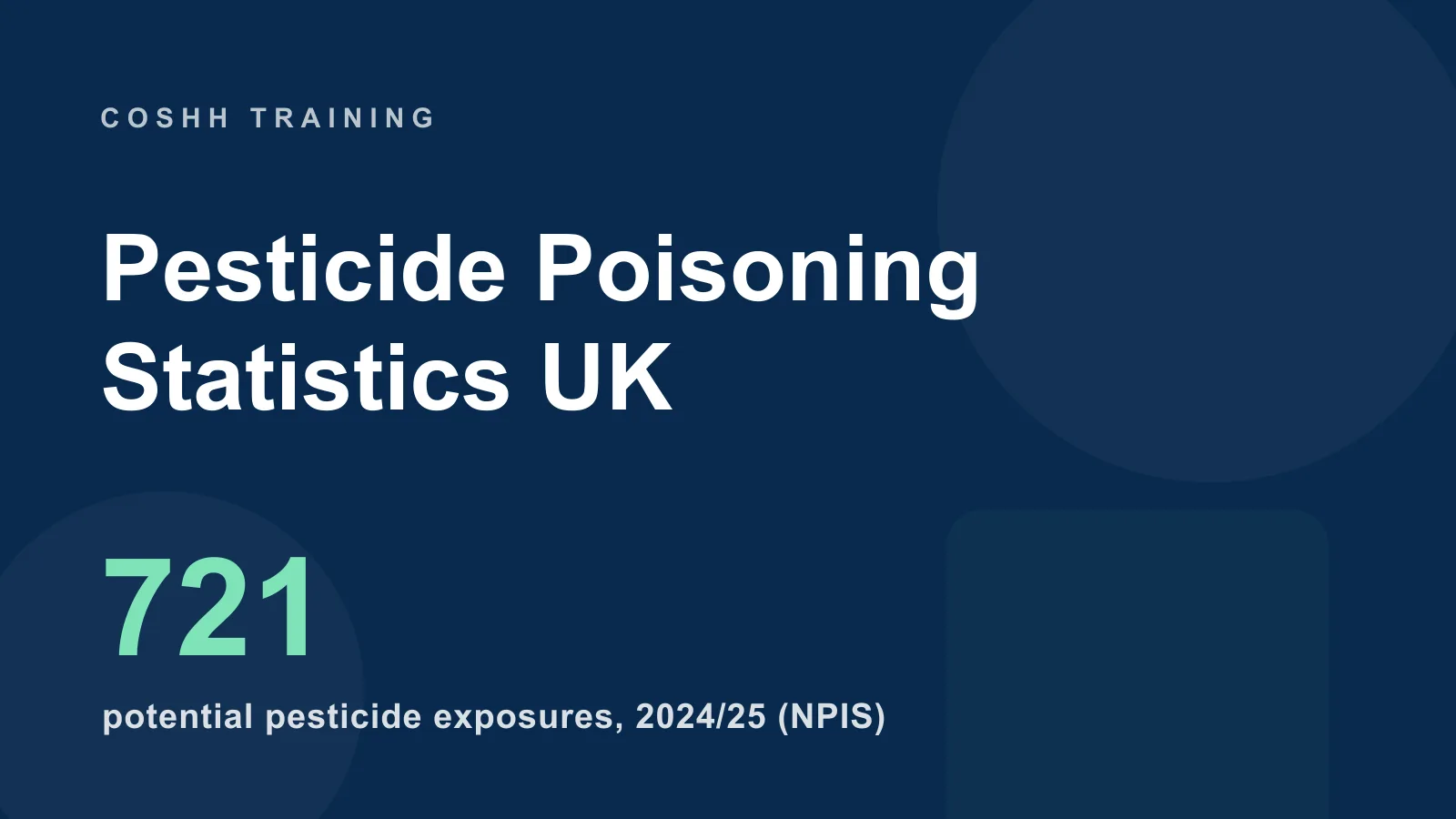
The NHS poisons service logged 721 potential UK pesticide exposures in 2024/25. The key UK pesticide poisoning and exposure statistics for 2026.
Pesticides — the herbicides, insecticides, fungicides and rodenticides used across farms, market gardens, greenkeeping and pest control — are hazardous substances with their own COSHH profile, yet the picture of how many people they harm at work is genuinely confusing. Official confirmed occupational poisoning counts look tiny, while the NHS surveillance system that tracks poisoning enquiries handles hundreds of pesticide cases a year. This page gathers the key UK figures in one place and explains why they diverge. The numbers are drawn from the National Poisons Information Service (NPIS) annual report, the Health and Safety Executive’s (HSE) reporting and enforcement guidance and Wildlife Incident Investigation Scheme, the Fera/HSE Pesticide Usage Survey published on GOV.UK, the 2025 UK Pesticides National Action Plan and campaign analysis from PAN-UK.
Key facts and figures
- 721 potential pesticide exposures were collated by the NHS National Poisons Information Service in 2024/25, of which 689 cases were analysed.
- 89.3% of the 689 analysed cases (615 of them) were graded no or mild severity; just 1 was fatal.
- 84.8% of analysed cases (584) were unintentional acute exposures, with 4.2% chronic and 9.7% deliberate self-harm.
- 5,174 TOXBASE accesses about pesticides of interest were recorded in 2024/25, up 23.9% on the previous year.
- ~100 incidents of possible pesticide poisoning of wildlife, pets and beneficial insects are recorded each year under HSE’s Wildlife Incident Investigation Scheme.
- ~12,000 people in UK agriculture suffered a job-caused or job-worsened illness in 2024/25 — the sector remains Britain’s riskiest.
- 2,200+ tonnes of glyphosate were applied to UK crops in 2024, up from around 200 tonnes in 1990 on PAN-UK’s analysis of Fera survey data.
- 0800 321 600 is the free 24-hour hotline for reporting suspected pesticide poisoning of wildlife or pets in Great Britain.
Figures are the latest available as of July 2026; this page is updated when new data is released — the NPIS annual report refreshes each year (the current edition covers April 2024 to March 2025), the Pesticide Usage Survey for arable crops refreshes biennially (the 2024 report was published on 1 December 2025), and WIIS quarterly data is amended each January, April, July and October.
How many pesticide poisoning cases are there in the UK each year?
The NHS National Poisons Information Service collated information on 721 potential pesticide exposures in 2024/25, of which 689 cases had enough detail to be analysed (NPIS report, April 2024 to March 2025). NPIS is the clinical service that advises NHS doctors, nurses and paramedics on treating poisoning, so its surveillance data is the most complete national picture of pesticide exposures the UK has. Alongside those cases, NPIS handled 476 pesticide-exposure telephone enquiries in the same year, up 12.5% from 423 in 2023/24, and recorded 5,174 accesses to its TOXBASE online database for pesticides of interest, up 23.9% from 4,176 the year before.
Crucially, that 721 is not a count of poisoned farm workers. NPIS surveillance captures domestic and accidental exposures as well as occupational ones — someone who swallows rat bait at home is counted the same way as a sprayer with a splash injury. Of the 689 analysed cases, 412 (59.8%) were adults and 274 (39.8%) were children aged 12 or under, and 357 (51.8%) were male against 311 (45.1%) female. Seven enquiries in 2024/25 involved pregnant patients, all acute, unintentional and graded no or mild severity. The large share of young children is a strong signal that a great deal of this activity is household accidents rather than workplace poisoning.
How serious are UK pesticide exposures?
Most are not serious at all: 615 of the 689 analysed cases (89.3%) were graded no or mild severity on the Poisoning Severity Score (PSS 0 or 1) in 2024/25 (NPIS report 2024 to 2025). Only 8 cases (1.2%) were moderate, 6 (0.9%) were severe, and a single case (0.1%) was fatal. By intent, 584 cases (84.8%) were unintentional acute exposures, 29 (4.2%) were chronic, and 67 (9.7%) were deliberate self-harm — the deliberate cases account for a disproportionate share of the small number of serious outcomes.
For an occupational audience the honest takeaway is that acute pesticide poisoning severe enough to reach the poisons service is rare, and severe or fatal cases rarer still. That does not mean the substances are safe to treat casually — chronic, low-level exposure and long-latency effects are exactly what surveillance figures capture poorly — but it does mean the headline risk from a single splash or spill, if handled properly, is usually mild. The table below summarises the 2024/25 severity breakdown.
| Severity (Poisoning Severity Score) | Cases | Share of 689 analysed |
|---|---|---|
| No or mild (PSS 0 or 1) | 615 | 89.3% |
| Moderate (PSS 2) | 8 | 1.2% |
| Severe (PSS 3) | 6 | 0.9% |
| Fatal (PSS 4) | 1 | 0.1% |
| Not graded / other | 59 | 8.6% |
Read across the whole column and the pattern is clear: the overwhelming majority of pesticide exposures the NHS is consulted about resolve with no or minor effects.
What are the most common pesticides involved in UK poisoning enquiries?
Permethrin was the single most frequently reported ingredient in 2024/25, with 83 reports, followed by glyphosate (59), the rodenticide bromadiolone (57), difenacoum (45) and brodifacoum (32) (NPIS report 2024 to 2025). NPIS also logged 89 cases involving unknown rodenticides and 30 involving unknown herbicides, so anticoagulant rat and mouse baits and weedkillers together make up a large slice of the caseload. That mix reflects what is actually in reach in homes, gardens and outbuildings: household insecticides, garden glyphosate weedkiller, and rodenticide bait blocks.
The surveillance system behind these figures is substantial. NPIS currently tracks 694 TOXBASE entries for pesticides and biocides through its DEFRA-funded pesticide surveillance system, which was established in 2004. Because the same active substances turn up in professional agricultural products and in consumer garden or pest-control products, the ingredient list is a useful cross-check for any workplace: if permethrin, glyphosate or an anticoagulant rodenticide is on your shelf, it belongs on your COSHH risk assessment and in your safety data sheet file.
Why do official UK pesticide poisoning figures look so low?
Confirmed occupational pesticide poisoning counts are very small — the Wildlife Incident Investigation Scheme records only around 100 possible poisoning incidents of wildlife, pets and beneficial invertebrates a year — and human occupational cases confirmed by HSE’s appraisal process are fewer still (HSE / WIIS). Suspected pesticide incidents thought to harm human health are assessed by the Pesticide Incidents Appraisal Panel (PIAP) and graded confirmed, likely, unlikely, not confirmed, or insufficient data, so only a fraction of reports end up as confirmed poisonings.
Three things drive the low counts. First, under-reporting: minor pesticide illness — a headache, nausea or skin irritation after spraying — is rarely reported to anyone, and HSE itself acknowledges pesticide-related ill health is under-reported. Second, diagnostic difficulty: many pesticide effects are non-specific and hard to attribute with confidence to a specific product. Third, the reporting system is deliberately conservative, requiring evidence before an incident is confirmed. So the true occupational picture almost certainly sits somewhere between the tiny confirmed counts and the broader surveillance activity — which is why every figure on this page should be read as indicative, not exact. For scale, HSE estimates around 12,000 people working in UK agriculture suffered an illness caused or made worse by their job in 2024/25, with asthma rates about twice the national average; agriculture, forestry and fishing is the UK’s riskiest industry sector, though only a share of that ill health is pesticide-related.
How many pesticide incidents harm wildlife and pets?
Around 100 incidents of possible pesticide poisoning of wildlife, pets and beneficial invertebrates are recorded each year under the Wildlife Incident Investigation Scheme (WIIS), which HSE runs with partners across Great Britain (HSE / WIIS quarterly reports). WIIS investigates suspected poisonings of animals and grades whether pesticides were involved and, if so, whether the use was approved, misuse or deliberate abuse. In 2020/21, WIIS assessed 37 animal-poisoning cases as abuse and 6 as misuse, with 21 of the abuse cases involving birds of prey — a reminder that a meaningful share of confirmed incidents are deliberate wildlife crime rather than accidental occupational exposure.
For anyone applying pesticides professionally, WIIS matters for two reasons: it is the route for reporting suspected wildlife or pet poisoning (via the free 24-hour hotline on 0800 321 600), and a confirmed misuse finding can trigger enforcement. Keeping bait secure, following label rates and clearing up spillages are as much about avoiding a WIIS incident as protecting the person doing the work.
How much pesticide is used on UK crops?
Around 14,798 tonnes of pesticide was applied to UK arable crops in 2022, across roughly 46.9 million hectares treated on about 4.0 million hectares grown (Fera/HSE Pesticide Usage Survey, arable UK 2022) — the multiple-treatment count is higher than the area grown because most fields are sprayed several times a season. Between 2020 and 2022 the total area treated with pesticides on UK arable crops rose 20% and the total weight applied rose 18%. The Pesticide Usage Survey for the 2024 season was published on 1 December 2025; arable crops account for roughly 85 to 90% of all pesticides applied to UK agricultural land, so the arable survey is the best available proxy for national farm use.
One active substance dominates the trend. Glyphosate applied to UK crops has risen from about 200 tonnes a year in 1990 to more than 2,200 tonnes in 2024 — roughly a 1,000% increase — with over 2.6 million hectares treated, according to PAN-UK’s analysis of Fera survey data. The long-run direction of total active-substance weight is downwards, however: the UK Pesticides National Action Plan 2025 reports that the weight of active substance applied to arable crops fell nearly 60%, from 19.96 kilotonnes in 1990 to 12.55 kilotonnes in 2020, and the 2025 plan targets at least a 10% cut in each of 20 Pesticide Load metrics by 2030 against a 2018 baseline.
| Measure | Figure | Period / source |
|---|---|---|
| Pesticide applied to UK arable crops | ~14,798 tonnes | 2022 (Fera/HSE PUS, arable UK) |
| Area treated on UK arable crops | ~46.9m hectares | 2022 (multiple treatments) |
| Change in area treated, 2020 to 2022 | +20% | Fera/HSE PUS |
| Glyphosate applied to UK crops | 2,200+ tonnes | 2024 (PAN-UK, on Fera data) |
| Active-substance weight, arable crops | 19.96 kt (1990) → 12.55 kt (2020) | UK Pesticides National Action Plan 2025 |
| Pesticide Load reduction target | ≥10% per metric by 2030 | 2018 baseline (2025 plan) |
How does the UK picture compare globally?
Globally the scale is vast: PAN-UK cites an estimate that 44% of farmers and farm workers — about 385 million people — are poisoned by pesticides every year, drawing on a systematic review of the global literature (PAN-UK). That worldwide figure is dominated by countries where hand-spraying of highly hazardous pesticides with little protective equipment is routine, so it cannot be read across to the UK, where approved-products controls, integrated pest management and mechanised application substantially lower per-worker exposure. It is included here only for context — to show why campaign groups treat pesticide exposure as a major occupational health issue worldwide even where national confirmed counts, as in the UK, look modest.
The honest UK position is a middle one: not the hundreds-of-millions of the global estimate, but not zero either. Surveillance shows hundreds of exposures a year reaching the NHS, mostly mild and mostly not occupational, sitting on top of an acknowledged layer of unreported minor illness among people who work with these substances day to day.
Who do you report pesticide exposure or poisoning to in the UK?
There is no single number — the route depends on what has been harmed. HSE’s guidance on reporting exposure to pesticides sets out the main channels: report human ill health you believe is caused by pesticides to HSE (or, for some premises, your local authority); report suspected poisoning of wildlife, pets or beneficial insects to the Wildlife Incident Investigation Scheme on the free 24-hour hotline 0800 321 600; and report water pollution to the Environment Agency in England, Natural Resources Wales, or the Scottish Environment Protection Agency (HSE — Report exposure to pesticides).
Serious cases of work-related ill health or dangerous occurrences involving pesticides may also be reportable by the employer under RIDDOR. And where a worker is actually unwell, the clinical route is the NHS — 111, a GP, or A&E for anything serious — with the treating clinicians able to consult NPIS. Getting the reporting route right matters: a confirmed misuse or abuse finding through these channels is what feeds the enforcement and appraisal statistics discussed above, and what can lead to prosecution.
Frequently asked questions
How many pesticide poisoning cases are there in the UK each year?
The NHS National Poisons Information Service collated 721 potential pesticide exposures in 2024/25, of which 689 were analysed. Almost 90% were graded no or mild severity and only one was fatal. These are surveillance cases that include domestic and accidental exposures, not a count of poisoned workers — confirmed occupational poisonings are far fewer.
Who do you report pesticide exposure or poisoning to in the UK?
It depends on what is affected. Report human ill health to HSE or your local authority; report suspected poisoning of wildlife or pets to the Wildlife Incident Investigation Scheme on 0800 321 600; and report water pollution to the Environment Agency, Natural Resources Wales or SEPA. If someone is unwell, seek NHS treatment (111, GP or A&E), and employers should check whether the case is reportable under RIDDOR.
What are the most common pesticides involved in UK poisoning enquiries?
In 2024/25 the most frequently reported ingredients to NPIS were permethrin (83 reports), glyphosate (59), and the rodenticides bromadiolone (57), difenacoum (45) and brodifacoum (32). NPIS also logged 89 cases involving unknown rodenticides and 30 involving unknown herbicides.
Why do official UK pesticide poisoning figures look so low?
Because minor pesticide illness is heavily under-reported, effects are often non-specific and hard to attribute, and the confirmation system is deliberately conservative — suspected human cases are graded confirmed, likely, unlikely, not confirmed or insufficient data by the Pesticide Incidents Appraisal Panel. The Wildlife Incident Investigation Scheme records only around 100 possible poisoning incidents a year, and confirmed human occupational cases are fewer still. All figures should be treated as indicative.
Are pesticides covered by COSHH?
Yes. Pesticides used at work are hazardous substances under the COSHH Regulations 2002, so employers must assess the risk, control exposure and provide information, instruction and training. Approval and use of pesticides also sit under separate plant protection and biocides legislation enforced by HSE, but the workplace health controls come through COSHH.
Related guides
- COSHH Statistics UK: Hazardous Substances at Work
- Silica Dust Statistics UK: Exposure, Silicosis & Deaths
- Occupational Dermatitis Statistics UK: Work-Related Skin Disease
- How to Carry Out a COSHH Risk Assessment
- COSHH Safety Data Sheets: How to Read and Use Them
Sources & references
- NPIS — National Poisons Information Service Report 2024 to 2025 (pesticide surveillance data)
- HSE — Report exposure to pesticides
- HSE — Pesticides: reporting incidents (PIAP appraisal)
- HSE — Wildlife Incident Investigation Scheme (WIIS) quarterly reports
- Fera / HSE — Pesticide Usage Survey report: arable crops in the UK 2024 (GOV.UK)
- Defra / HSE — UK Pesticides National Action Plan 2025 (GOV.UK)
- PAN-UK — Pesticide poisoning (global and UK context)
- PAN-UK — Glyphosate use in UK farming (analysis of Fera PUS data)
- HSE — Health and safety in agriculture (ill-health and fatal-injury statistics)
- HSE — Pesticides hub (approvals, controls, PPE/RPE and sector guidance)
Pesticides are COSHH substances — make sure everyone who mixes, sprays or stores them can recognise the risk and apply the right controls.
Explore the COSHH Training course →
Mark writes about workplace health & safety, COSHH and accredited online training for COSHH Training, part of Online CPD Academy.