
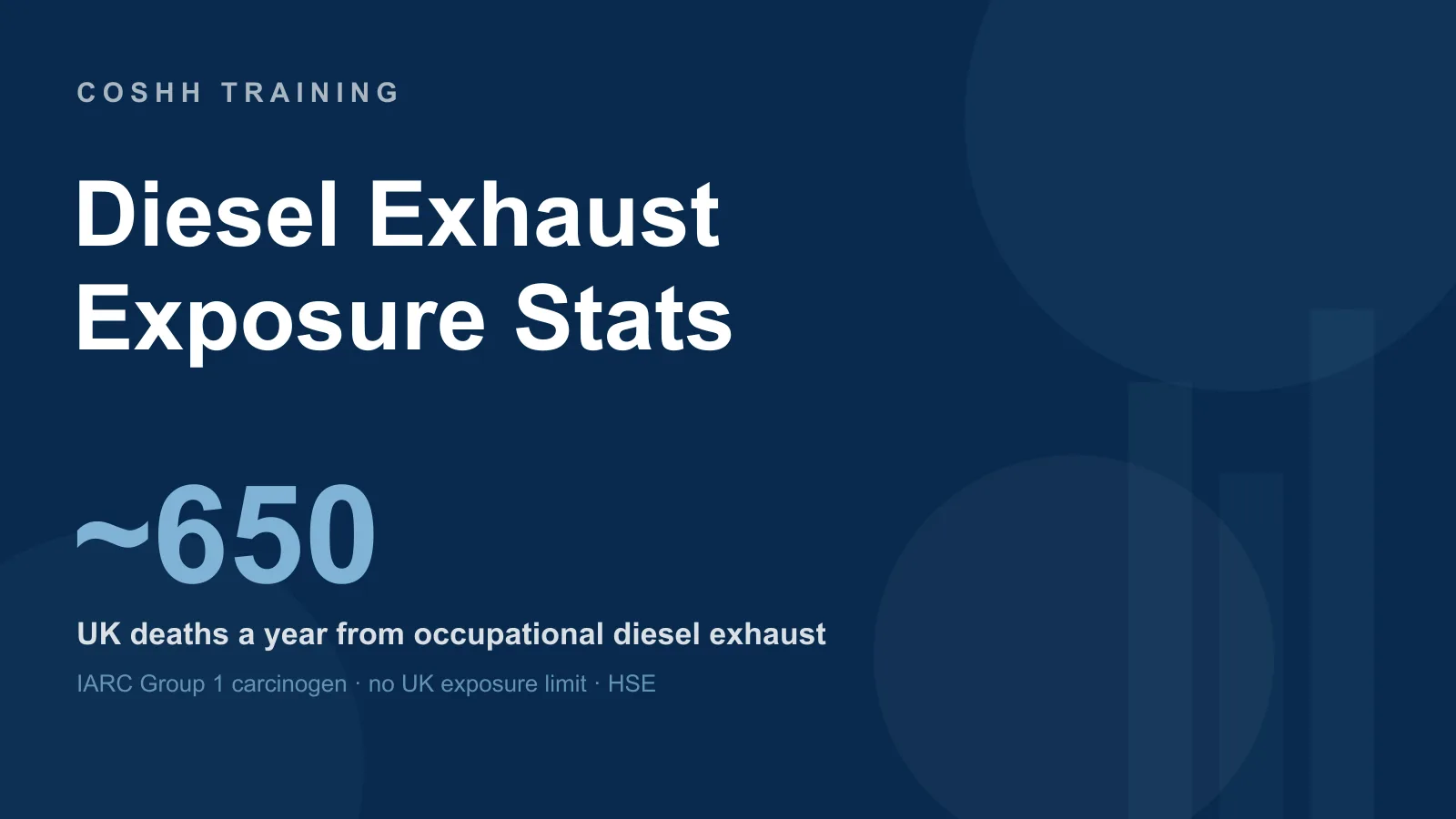
Diesel engine exhaust contributes to about 650 UK deaths a year, mostly lung and bladder cancer. Key UK diesel exhaust exposure statistics for 2026.
Diesel engine exhaust emissions (DEEE) are one of the most widespread occupational carcinogens in Britain, yet unlike silica or asbestos they carry no legal workplace exposure limit. This page gathers the key UK statistics in one place: how many deaths are attributed to diesel exhaust each year, its share of the occupational lung-cancer burden, which trades are most exposed, and the regulatory gap that leaves Britain without a limit the EU already has. The figures are drawn from the Health and Safety Executive’s (HSE) occupational cancer burden research, the British Occupational Hygiene Society (BOHS), the International Agency for Research on Cancer (IARC) and the Industrial Injuries Advisory Council (IIAC).
Key facts and figures
- ~650 UK deaths a year are attributed to occupational diesel engine exhaust exposure, chiefly lung and bladder cancer (HSE burden estimate; ~652 in the detailed breakdown).
- ~605 of those are occupational lung cancer deaths, with a further ~47 bladder cancer deaths each year (HSE burden research).
- 3rd — DEEE is the third-largest occupational contributor to the UK lung-cancer burden, after asbestos and silica (Rushton et al., 2012).
- 1.84% of occupational lung cancer is attributable to diesel exhaust in HSE’s estimate (2005 exposure base).
- Group 1 — IARC classified diesel engine exhaust as “carcinogenic to humans” on 12 June 2012, upgraded from “probably carcinogenic” (Group 2A, 1988).
- No WEL — Great Britain sets no workplace exposure limit for DEEE; exposure is controlled under COSHH to as low as reasonably practicable.
- 0.05 mg/m³ is the EU’s binding elemental-carbon limit for DEEE, mandatory across member states since 21 February 2023 — a limit Britain did not adopt.
- 3 Feb 2026 — BOHS published new DEEE cancer-risk guidance, the freshest UK anchor, 14 years after IARC’s Group 1 classification.
Figures are the latest available as of July 2026. The ~650 death estimate is a 2012 Rushton/HSE figure based on 2005 exposures, so it is reviewed on a slow cadence; this page is updated on new BOHS guidance, any future GB workplace-exposure-limit decision, or a periodic HSE occupational-cancer burden update.
How many people die from diesel exhaust exposure at work in the UK?
Around 650 deaths a year in the UK are attributed to occupational exposure to diesel engine exhaust emissions, primarily from lung and bladder cancer, according to HSE’s occupational cancer burden research reaffirmed in BOHS’s February 2026 guidance. The detailed HSE breakdown puts the figure at about 652 deaths a year: roughly 605 occupational lung cancer deaths plus around 47 bladder cancer deaths. These estimates rest on the Rushton et al. burden study (published 2012 in the British Journal of Cancer), which modelled deaths in 2005 from exposures reaching back up to 50 years earlier.
It is important to read that number for what it is. Diesel-related lung cancer is clinically indistinguishable from lung cancer caused by smoking or other exposures, so it almost never appears on a death certificate as diesel-related. The ~650 figure is a modelled estimate of the share of cancers caused by past occupational exposure, not a count of certified diesel deaths. Because it derives from 2005 exposure data, it should be treated as a long-standing HSE estimate rather than a fresh annual measurement — diesel technology and workplace controls have moved on since then, but no updated national burden figure has yet replaced it.
How big is diesel exhaust’s share of occupational lung cancer?
1.84% of all occupational lung cancer in Great Britain is attributable to diesel engine exhaust emissions in HSE’s estimate (2005 exposure base). That may sound small, but against the scale of the occupational lung-cancer burden it makes diesel exhaust the third most important occupational contributor to the UK lung-cancer burden, after asbestos and silica (Rushton et al., 2012). Only those two long-recognised carcinogens account for more occupational lung-cancer deaths.
For context — and this is the figure the COSHH statistics umbrella page owns rather than this one — occupational cancer overall accounts for around 8,000 deaths and 13,500 new cancer registrations a year in Great Britain, again on the 2005 burden base. Diesel exhaust is one recognisable substance slice within that total. HSE lists diesel engine exhaust emissions among its top-ten occupational cancer “priorities for prevention,” which is why it sits alongside asbestos, silica and welding fume in the regulator’s thinking despite the absence of a dedicated exposure limit.
Diesel exhaust statistics at a glance
The table below summarises the headline UK measures and where each one currently stands.
| Measure | Latest figure | Period / source |
|---|---|---|
| UK deaths a year attributed to occupational DEEE | ~650 (≈652) | HSE burden estimate (2005 base) |
| Of which occupational lung cancer deaths | ~605 a year | HSE burden research |
| Of which bladder cancer deaths | ~47 a year | HSE burden research |
| Diesel’s attributable fraction of occupational lung cancer | 1.84% | HSE estimate, 2005 exposures |
| Rank among occupational lung-cancer contributors | 3rd (after asbestos, silica) | Rushton et al., 2012 |
| Construction workers dying early from past diesel exposure | 200+ (2005) | HSE Cancer and construction |
| IARC carcinogen classification | Group 1 (“carcinogenic to humans”) | 12 June 2012 |
| GB workplace exposure limit (WEL) | None | Current — control to ALARP under COSHH |
| EU binding exposure limit (elemental carbon) | 0.05 mg/m³ | Mandatory from 21 Feb 2023 |
Which workers are most exposed to diesel engine exhaust?
Over 200 construction workers are estimated to have died prematurely in 2005 from past diesel-exhaust exposure — an estimate based on exposures up to 50 years earlier (HSE, Cancer and construction). Construction is not the only exposed sector, but it is a heavily affected one: HSE estimates that construction accounts for over 40% of occupational cancer deaths and cancer registrations across all sectors, a share that reflects the trade’s combined exposure to silica, asbestos and diesel exhaust from plant and vehicles.
The highest-exposure trades named by HSE, IARC and BOHS are broad. They include HGV, bus and coach drivers; miners; construction and heavy-plant operators; forklift-truck drivers; railway and dock workers; and garage mechanics and motor-vehicle repair (MVR) technicians. Warehousing and logistics staff working near running diesel engines, and anyone working in enclosed or poorly ventilated spaces where diesel plant operates, face raised exposures too. Because the dust and fume are generated by the work itself rather than supplied in a labelled container, diesel exhaust is one of the hazards most easily overlooked in a COSHH risk assessment — there is no supplier safety data sheet for the fumes coming off a running engine, even though DEEE is firmly a substance the COSHH regime covers.
Is diesel exhaust actually a carcinogen?
Yes. IARC classified diesel engine exhaust as a Group 1 carcinogen — its highest category, “carcinogenic to humans” — on 12 June 2012, upgrading it from Group 2A (“probably carcinogenic to humans,” where it had sat since 1988). The reclassification followed accumulating epidemiological evidence, most notably long-running studies of diesel-exposed workers. IARC found sufficient evidence that diesel exhaust causes lung cancer in humans, and a positive but more limited association with bladder cancer.
One of the headline studies behind the burden estimate is the US railroad-worker cohort analysed by Garshick and colleagues (2004), in which diesel-exposed railroad workers showed a roughly 40% higher lung-cancer mortality risk (relative risk around 1.40). The Industrial Injuries Advisory Council (IIAC) reviewed this and related evidence in a 2015 information note on lung and bladder cancer and diesel exhaust. Short-term exposure to diesel fumes can also cause immediate effects — eye and respiratory irritation, headaches, nausea and dizziness — but it is the long-term, cumulative exposure that drives the cancer risk that makes DEEE a COSHH priority.
Is there a workplace exposure limit for diesel exhaust in the UK?
No — Great Britain sets no workplace exposure limit (WEL) for diesel engine exhaust emissions. Instead, because DEEE is a carcinogen, exposure must be controlled under the COSHH Regulations 2002 to as low as reasonably practicable (ALARP). That means employers cannot simply measure against a number and declare compliance; they are expected to apply the COSHH hierarchy of control — substituting electric or lower-emission plant where possible, using local exhaust ventilation and tailpipe extraction, keeping engines out of enclosed spaces, and using respiratory protection only as a supplement.
The contrast with the EU is stark. The EU introduced a binding occupational exposure limit of 0.05 mg/m³, measured as elemental carbon, for diesel engine exhaust under the Carcinogens and Mutagens Directive (2004/37/EC, as amended in 2019). The limit became mandatory across member states from 21 February 2023, with a three-year extension to February 2026 for underground mining and tunnel construction. Britain, having left the EU, did not adopt this limit — leaving a policy gap that unions, BOHS and IOSH continue to press on. BOHS published fresh DEEE cancer-risk guidance on 3 February 2026 to complement HSE’s HSG187 control guidance, reflecting updated science 14 years after IARC’s Group 1 classification. (Asbestos, a separate and more heavily regulated carcinogen, is covered on our dedicated asbestos awareness site rather than here.)
Frequently asked questions
How many people die from diesel exhaust exposure at work in the UK each year?
Around 650 deaths a year in the UK are attributed to occupational diesel engine exhaust exposure, chiefly lung and bladder cancer — roughly 605 lung cancer deaths and about 47 bladder cancer deaths in HSE’s detailed breakdown. The figure is a modelled estimate from HSE’s occupational cancer burden research (Rushton et al., 2012), based on 2005 exposures, not a count of certified diesel deaths.
Is there a workplace exposure limit for diesel engine exhaust in the UK?
No. Great Britain has no workplace exposure limit for diesel engine exhaust emissions. Because DEEE is a carcinogen, COSHH instead requires exposure to be reduced as low as reasonably practicable. The EU, by contrast, has a binding 0.05 mg/m³ elemental-carbon limit in force since February 2023, which Britain did not adopt post-Brexit.
Which workers are most exposed to diesel engine exhaust emissions?
The most exposed trades named by HSE, IARC and BOHS are HGV, bus and coach drivers; miners; construction and heavy-plant operators; forklift drivers; railway and dock workers; and garage mechanics and MVR technicians. Warehousing, logistics and anyone working near running diesel engines in enclosed spaces also face raised exposures.
Is diesel exhaust actually a carcinogen?
Yes. IARC classified diesel engine exhaust as a Group 1 carcinogen — “carcinogenic to humans” — on 12 June 2012, upgraded from Group 2A. There is sufficient evidence that it causes lung cancer, and a positive but limited association with bladder cancer. It ranks third among occupational contributors to the UK lung-cancer burden, after asbestos and silica.
What is DEEE?
DEEE stands for diesel engine exhaust emissions — the mixture of gases and fine particulate (including elemental carbon) produced when a diesel engine burns fuel. It is the substance IARC classifies as a Group 1 human carcinogen, and the fine soot particles are what carry the long-term cancer risk to the lungs and bladder.
Related guides
- COSHH Statistics UK: Hazardous Substances at Work
- Silica Dust Statistics UK: Exposure, Silicosis & Deaths
- Occupational Dermatitis Statistics UK: Work-Related Skin Disease
- How to Carry Out a COSHH Risk Assessment
- The COSHH Hierarchy of Control: How to Choose Controls in the Right Order
Sources & references
- BOHS — Diesel Engine Exhaust Emissions cancer-risk guidance (3 February 2026)
- HSE — Cancer and construction: Diesel engine exhaust emissions
- HSE — Cancer and construction: Key points
- HSE — HSG187: Control of diesel engine exhaust emissions in the workplace
- Rushton et al. — The burden of occupational cancer in Great Britain (British Journal of Cancer, 2012)
- IIAC — Lung and Bladder Cancer and Diesel Exhaust Emissions (information note, September 2015)
- IARC (WHO) — Press release 213: Diesel Engine Exhaust Carcinogenic (Group 1), 12 June 2012
- IOSH — Diesel fumes / preventing occupational cancer guidance
- ETUI — EU Carcinogens & Mutagens Directive 2004/37/EC: new limit values (DEEE 0.05 mg/m³, in force 21 Feb 2023)
Diesel engine exhaust is a COSHH carcinogen with no exposure limit to hide behind — make sure your team can recognise the risk and apply the right controls.
Explore the COSHH Training course →
Mark writes about workplace health & safety, COSHH and accredited online training for COSHH Training, part of Online CPD Academy.