
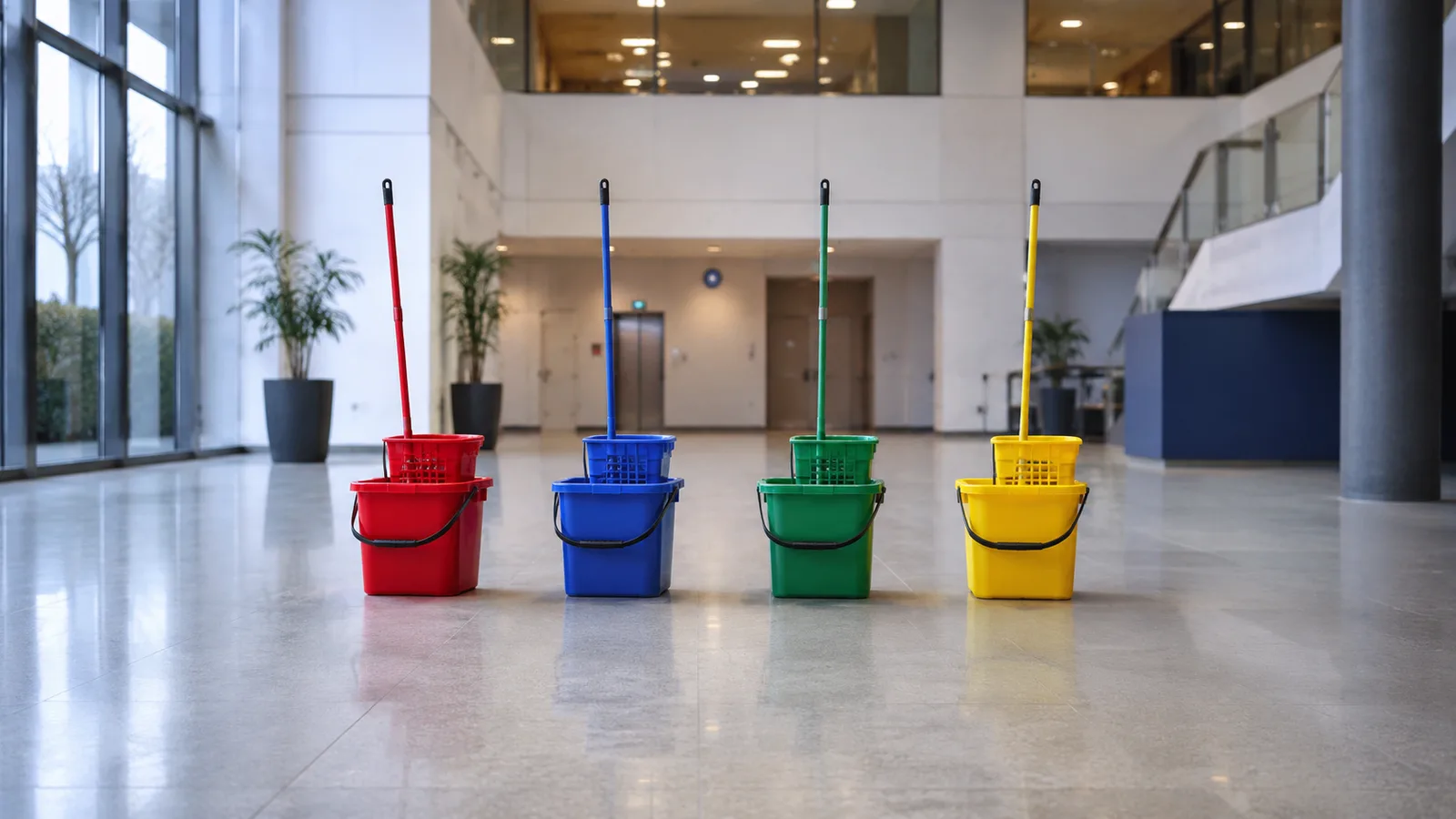
The four-colour system used in UK cleaning to prevent cross-contamination, how it differs between healthcare and hospitality, and where it sits in the wider regulatory framework.
The red mop in the toilets, the yellow cloth in the kitchen, the blue bucket for general areas — the four-colour cleaning system is one of the most visible parts of any cleaning operation, particularly in healthcare and hospitality. It exists for a specific reason: stopping cleaning equipment used in one area from carrying contamination to another. A mop that’s just cleaned a toilet floor has no business in a food preparation area, and a cloth that’s wiped a kitchen surface shouldn’t be moving on to a patient’s bedside table.
The system is often referred to as “COSHH colour coding” and you’ll find it covered in COSHH training material, though strictly speaking it isn’t part of COSHH itself. It’s an industry convention enforced through guidance and professional standards rather than statutory law. This page explains where it comes from, what the colours mean in different industries, and how it sits within the wider COSHH framework. For the broader picture, see what COSHH is.
Where the colour code comes from
The four-colour cleaning system developed within the UK cleaning industry from the late 1990s, championed by the British Institute of Cleaning Science (BICSc) as a means of preventing cross-contamination. It became the de facto standard within commercial cleaning, with operatives trained to associate each colour with a specific area type.
The system was formalised within the NHS in 2007 when the National Patient Safety Agency (NPSA) issued Safer Practice Notice 15: “Colour coding hospital cleaning materials and equipment”. The notice established the four-colour system across NHS trusts in England and Wales as part of broader infection prevention and control measures, and the colour conventions used in healthcare today come directly from that notice.
NPSA itself was abolished in 2012, with its functions transferred to NHS England. The colour-coding convention survived the abolition and is now embedded in NHS national standards of healthcare cleanliness, in CQC inspection criteria, and in supplier product ranges across the industry.
The point worth understanding is that the system used in healthcare and the system used in hospitality, food service and other industries are similar but not identical. Both use the same four colours — red, blue, green, yellow — but the mapping of colours to areas differs significantly between the two sectors. Workers crossing from one industry to the other have to consciously relearn the colour code.
The colour code in healthcare
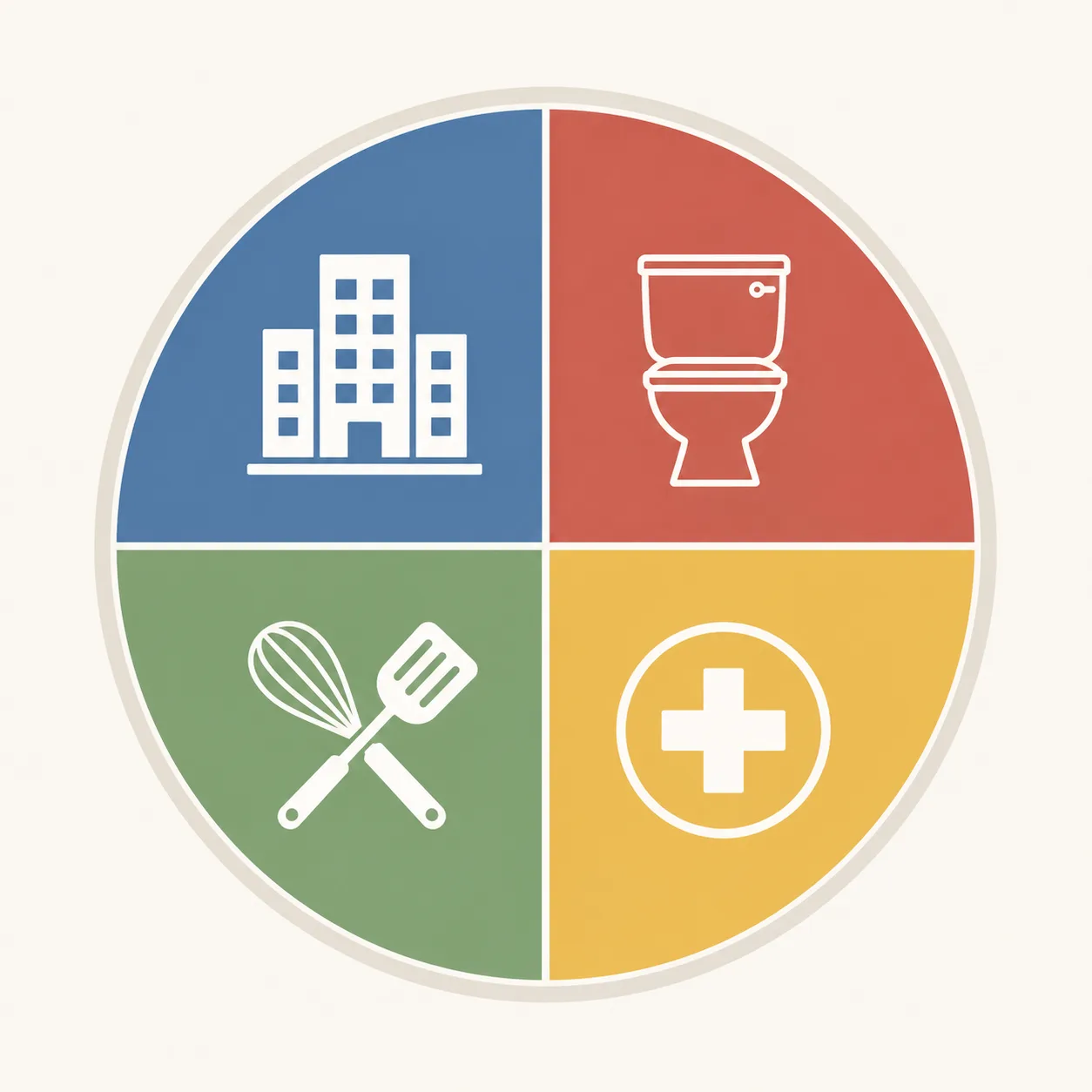
The NPSA scheme — still the operative standard in NHS settings — uses the following mapping:
- Red for sanitary areas, including bathrooms, toilets, washroom floors and basins, urinals, sluices and the immediate areas around them
- Blue for general areas, including offices, corridors, waiting rooms, reception areas, communal spaces and lower-risk patient areas
- Green for catering and food preparation areas, including ward kitchens, main kitchens, dining rooms and food storage
- Yellow for clinical areas, including isolation rooms, treatment rooms, infectious patient areas and any area where infection control is critical
In healthcare practice, every piece of cleaning equipment — mops, mop heads, cloths, buckets, sprays, aprons, gloves where colour-coded — is assigned a colour and used only within the corresponding area. Equipment is stored in colour-coded racks, and many sites have separate cleaning stores for each colour. Even disposable wipes and microfibre cloths come pre-coded.
The strictness of the system reflects the consequences of cross-contamination in healthcare. A microfibre cloth used in an isolation room could carry resistant organisms into a kitchen if it wasn’t kept separate. A mop used in a toilet could carry faecal contamination into a clinical area. The four colours create a visible barrier against errors that wouldn’t otherwise be caught.
The colour code in hospitality
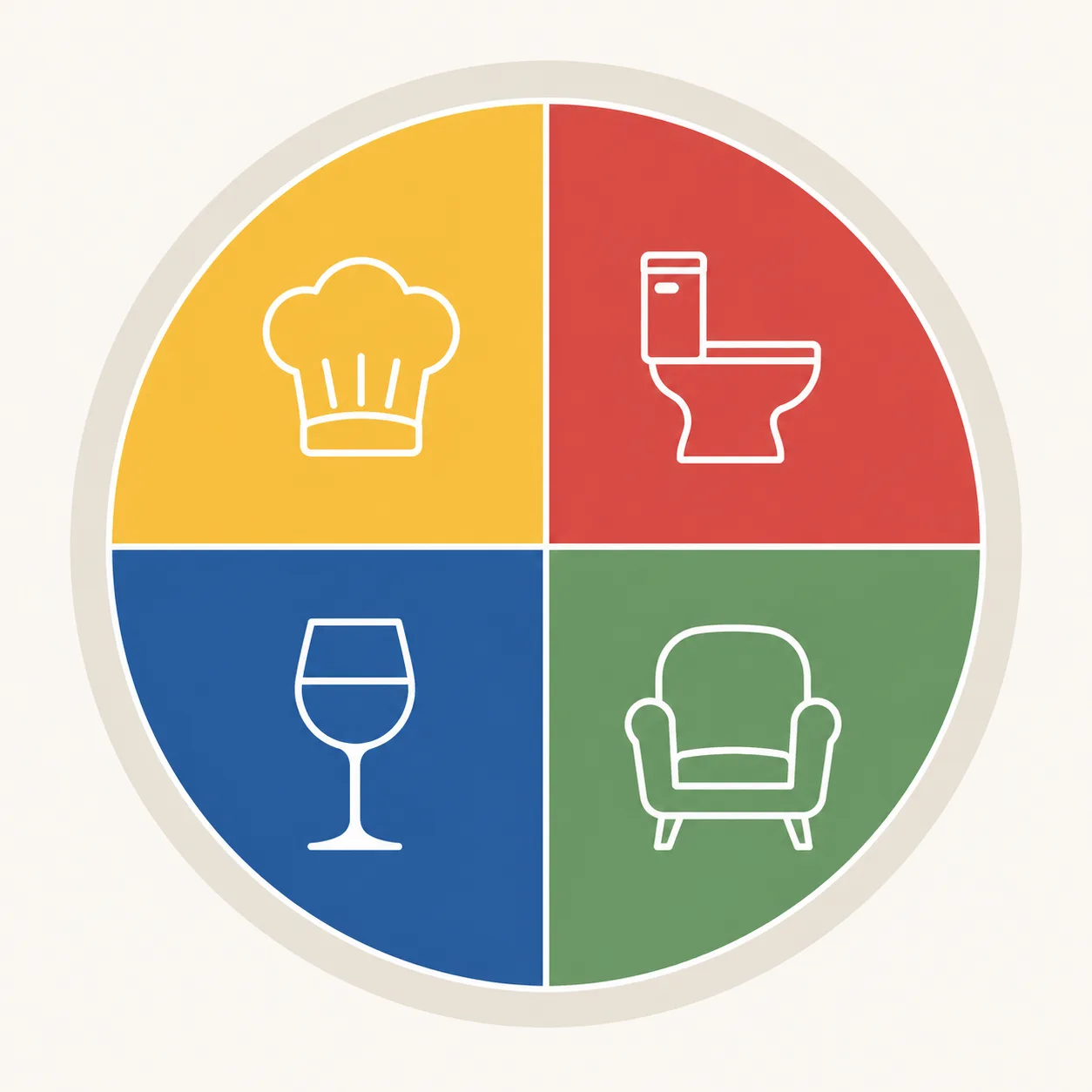
Hospitality — restaurants, bars, hotels, contract catering, function venues — uses a different mapping. The most widely-used hospitality convention is:
- Red for high-risk and sanitary areas, primarily washrooms and toilets
- Yellow for kitchen and food preparation areas
- Blue for bar areas, dining rooms and front-of-house areas where food and drink is served
- Green for low-risk general areas — public corridors, lobbies, back-of-house circulation, function spaces
The reasoning is similar to healthcare: cross-contamination between food and non-food areas is the primary concern, with the additional consideration of preventing chemical residues from getting onto surfaces that come into contact with food. A cloth used to clean a toilet must not subsequently clean a bar surface.
Note that yellow means kitchens in hospitality but isolation in healthcare. This is the most common source of confusion when workers move between industries — a yellow-coded cloth used in an NHS isolation room would be used in a hotel kitchen under the hospitality convention. The colour itself carries no inherent meaning; it’s the system that gives it meaning, and the system isn’t universal.
Side-by-side comparison
The two sector conventions next to each other:
| Area type | Healthcare (NPSA / BICSc) | Hospitality |
|---|---|---|
| Washrooms, toilets, sanitary areas | Red | Red |
| Kitchens and food preparation | Green | Yellow |
| General areas (offices, corridors) | Blue | Green |
| High-risk specialist areas | Yellow (clinical / isolation) | — |
| Front-of-house dining / bars | — | Blue |
Workers operating across both sectors — for example, contract cleaning companies serving both NHS trusts and hospitality clients — need to be trained on both. A worker accustomed to “yellow = isolation” in the morning at a hospital can’t safely apply that mental model when working a hotel kitchen in the afternoon.
The differences also mean that suppliers selling colour-coded products serve both markets with the same colours but very different marketing — a yellow microfibre cloth for healthcare is sold as “isolation grade” while the equivalent cloth for hospitality is sold as “food-safe kitchen grade”. The cloth is the same; the labelling reflects the destination industry.
How colour coding fits under COSHH
Colour coding is not part of the COSHH Regulations and isn’t a statutory requirement outside the NHS. It’s an administrative control measure — one of the lower tiers in the COSHH hierarchy of control — that supports the broader objective of preventing exposure to hazardous substances.
Where it intersects with COSHH most directly is in two areas.
Preventing chemical cross-contamination
Cleaning chemicals used in one area shouldn’t end up in another. A bleach-based toilet cleaner finding its way onto a food preparation surface creates both a chemical risk and a food safety risk. The colour-coded equipment ensures that residues stay with the area they were generated in.
Preventing biological cross-contamination
Biological agents — bacteria, viruses, fungi — are in scope of COSHH. In healthcare and food service, the risk of biological cross-contamination is a primary concern, and the colour code is the most effective practical control against it. For the wider picture of which substances COSHH covers, see substances covered by COSHH.
The COSHH risk assessment for cleaning operations should document the colour coding as one of the administrative controls in place. The substance assessments — see the COSHH risk assessment template — should reference it where the substance is used in a colour-coded area, and the training records should show workers have been trained on the convention used at their workplace.
CQC expectations and the wider regulatory picture
In healthcare settings, the colour-coding system isn’t optional. The Health and Social Care Act 2008 (Regulated Activities) Regulations 2014 require care providers to have effective infection prevention and control measures in place. The associated Code of Practice on the prevention and control of infections — usually known as the Hygiene Code — specifies the controls expected, including colour-coded cleaning equipment.
The Care Quality Commission inspects against the Hygiene Code. An NHS trust or registered care provider that didn’t operate the colour-coding system would be in breach of the regulations and could face enforcement action, up to and including suspension of registration. CQC inspection reports routinely cite the implementation of colour-coded cleaning as one of the indicators of effective infection prevention.
In non-healthcare settings, the position is different. There’s no statute or regulation that mandates the four-colour system. Food businesses must prevent contamination under food hygiene law, but they aren’t told how. Most hospitality operators adopt the colour-coding system because it’s the most practical way to demonstrate the controls they need under food safety law and through schemes like the Food Hygiene Rating Scheme — not because they’re legally required to.
This distinction matters in two ways. First, a hospitality business that decides to use a different system isn’t in breach of law as long as the system actually prevents cross-contamination. Second, a healthcare provider that decided to deviate from the NPSA scheme would need to demonstrate equivalent or better infection control through their own evidence, which in practice is rarely worth the regulatory exposure.
Implementing colour coding in a workplace
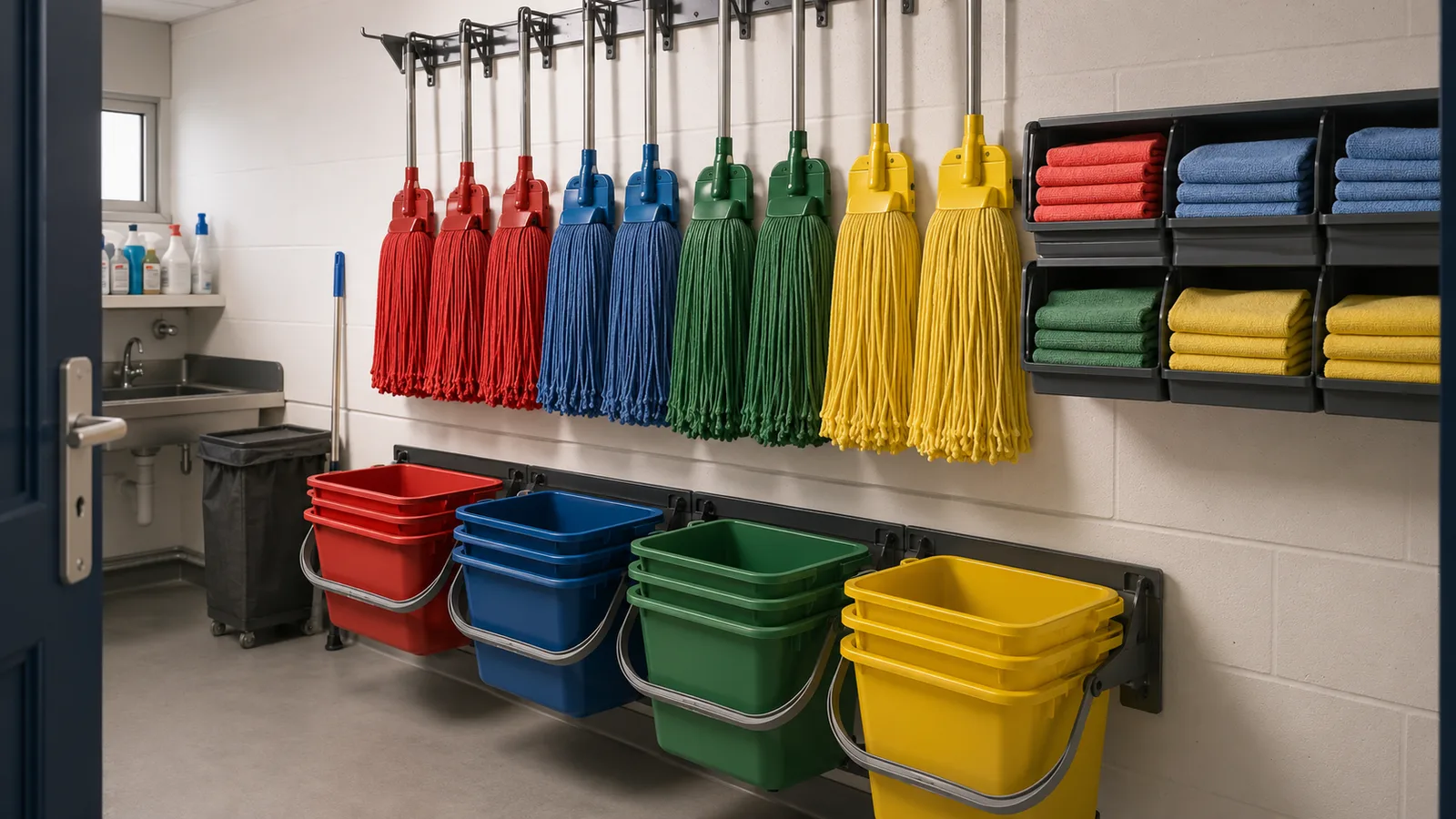
Putting the colour code into practice involves several elements working together.
Equipment procurement
Mops, mop heads, buckets, cloths, microfibre wipes, sprays, brushes, aprons, gloves and any other equipment that touches surfaces are supplied or sourced in the four colours. Colour-coded racks and storage trolleys complete the visual system.
Storage
Colour-coded equipment is stored in colour-coded sections, often in separate stores. The visual separation makes it harder to use the wrong equipment by mistake.
Signage
Visible signs at the entrance to each area type indicate which colour applies. In NHS settings, signs at the entrance to clinical areas, kitchens and sanitary areas are standard practice.
Procedures
Written cleaning procedures specify which colour to use for which task. Workers follow the procedure for each room or area.
Training
Workers learn the colour code as part of induction and refresher training. Where a worker moves between sectors with different colour conventions, the training has to address both explicitly. Structured COSHH Training typically covers colour coding as one element of safe cleaning practice, alongside chemical handling, PPE and emergency response.
Audit
Periodic checks confirm that the colour code is being applied correctly — the right equipment in the right place, the right colour in use for each task, the right storage. CQC inspections in healthcare include this check; internal audits in hospitality serve the same purpose.
The most common implementation failure isn’t the absence of colour-coded equipment — most workplaces have it. The failure is mixing — yellow buckets used in general areas because the blue bucket was elsewhere, red cloths used at break times because they were the only ones available. Training and supervision keep the system honest.
Frequently asked questions
Is colour-coded cleaning a legal requirement?
In NHS and registered care settings, yes — the Health and Social Care Act 2008 regulations and the associated Hygiene Code require effective infection prevention and control, with the NPSA colour code as the standard. In non-healthcare settings (hospitality, retail, offices, manufacturing), the colour code is industry good practice rather than statutory law.
What colour is used for toilets and bathrooms?
Red, in both the healthcare and hospitality colour codes. This is the one mapping that’s consistent across sectors.
What colour is used for kitchens?
Green in healthcare (NPSA / BICSc), yellow in hospitality. This difference is the most frequent source of confusion when workers move between sectors.
Can I use my own colour system?
In non-healthcare settings, yes — as long as the system actually prevents cross-contamination and you can demonstrate it works. In NHS and registered care settings, deviating from the NPSA convention would put you out of step with the Hygiene Code and would likely raise questions at CQC inspection.
Do CQC inspections check colour coding?
Yes. CQC inspects against the Health and Social Care Act 2008 regulations and the associated Hygiene Code. Implementation of colour-coded cleaning is one of the indicators of effective infection prevention and control that inspectors check, and inspection reports frequently cite it where it’s done well or where it’s missing.
Related guides
- The 8 Steps to COSHH Compliance
- The COSHH Hierarchy of Control: How to Choose Controls in the Right Order
- COSHH Safety Data Sheets (SDS): What They Are and How to Use Them
Make sure your team is trained to recognise hazardous substances and clean safely under COSHH.
Explore the COSHH Training course →
Mark writes about workplace health & safety, COSHH and accredited online training for COSHH Training, part of Online CPD Academy.